
Managing Cybersecurity Risk: A Practical Guide for 2026
Managing cybersecurity risk has become a fundamental business requirement rather than an optional technical exercise. Organizations today face an expanding threat landscape where ransomware, data breaches, supply chain compromises, and compliance failures can disrupt operations and damage reputation overnight. For business decision-makers without dedicated internal security teams, understanding how to systematically identify, assess, and treat cybersecurity risk determines whether your organization builds resilience or remains vulnerable to preventable incidents.
Understanding the Foundation of Risk Management
Risk management in cybersecurity is not about eliminating every possible threat. Instead, it focuses on understanding which risks matter most to your business, determining acceptable levels of exposure, and allocating resources where they deliver measurable protection.
The NIST Cybersecurity Framework 2.0 provides a structured approach that organizations worldwide use to organize their risk management activities. This framework emphasizes governance, identification, protection, detection, response, and recovery as interconnected functions rather than isolated technical tasks.
Building a Risk Register
Every effective program for managing cybersecurity risk begins with a documented risk register. This living document captures identified risks, their potential business impact, likelihood of occurrence, and planned treatments.
Your risk register should include:
- Asset inventory: Systems, data, applications, and infrastructure that require protection
- Threat scenarios: Realistic attack vectors relevant to your industry and technology stack
- Vulnerability assessments: Known weaknesses in configurations, software, or processes
- Impact ratings: Financial, operational, reputational, and compliance consequences
- Likelihood estimates: Probability based on threat intelligence and control maturity
The register becomes a communication tool that helps executives understand exposure and justify security investments based on business priorities rather than technical preferences.
Implementing Practical Risk Assessment Methods
Managing cybersecurity risk requires regular assessment cycles that keep pace with changing business operations and emerging threats. Assessment methodologies range from qualitative workshops to quantitative modeling, with most organizations benefiting from a hybrid approach.
Qualitative Assessment Workshops
Facilitated workshops bring together stakeholders from IT, operations, finance, and legal teams to evaluate risk scenarios collaboratively. These sessions identify risks that technical scanning tools might miss, such as process gaps, third-party dependencies, or business logic vulnerabilities.
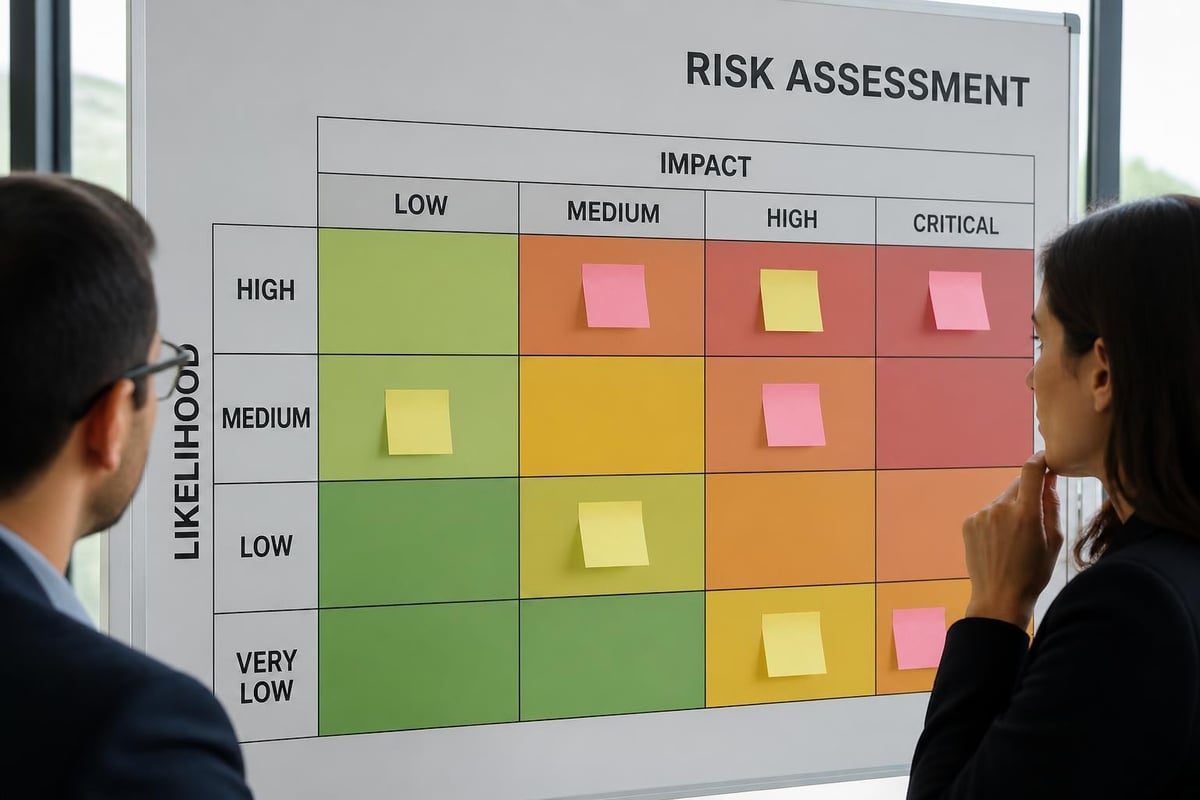
Workshop participants rate each risk scenario using standardized scales for likelihood and impact. The resulting risk matrix provides visual prioritization that non-technical executives can easily interpret and use for decision-making.
Quantitative Risk Analysis
For organizations requiring precise financial justification, quantitative methods assign dollar values to potential losses. This approach calculates annualized loss expectancy by multiplying the single loss expectancy by the annual rate of occurrence.
| Risk Component | Definition | Example Value |
|---|---|---|
| Asset Value | Replacement cost plus business impact | $2,500,000 |
| Exposure Factor | Percentage of asset value at risk | 40% |
| Single Loss Expectancy | Asset value × exposure factor | $1,000,000 |
| Annual Rate of Occurrence | Expected frequency per year | 0.2 (once every 5 years) |
| Annualized Loss Expectancy | SLE × ARO | $200,000 |
This financial perspective helps justify control investments when the annualized cost of protection remains lower than the expected loss.
F&C's information security risk management service helps organizations establish assessment methodologies that balance rigor with practicality, ensuring risk analysis supports rather than delays business decisions.
Threat-Informed Risk Assessment
Traditional risk assessments often rely on generic threat lists that lack relevance to your actual attack surface. Threat-informed approaches use frameworks like MITRE ATT&CK to model how real adversaries would target your specific environment.
This method maps your assets and controls against known adversary tactics, techniques, and procedures. The gap analysis reveals where attackers could succeed despite existing defenses, allowing you to prioritize controls based on actual exposure rather than theoretical vulnerability counts.
Designing Risk Treatment Strategies
Once assessment identifies and prioritizes risks, organizations must decide how to treat each one. Managing cybersecurity risk effectively means choosing the appropriate treatment based on cost, feasibility, and risk appetite.
The Four Treatment Options
Every identified risk requires a documented treatment decision from among four standard options:
- Avoid: Eliminate the risk by discontinuing the vulnerable activity or asset
- Reduce: Implement controls that lower likelihood or impact to acceptable levels
- Transfer: Shift financial consequences to insurance or contractual arrangements
- Accept: Formally acknowledge risks that fall within appetite and require no further action
Most organizations apply a combination of these treatments across their risk portfolio. Critical risks typically require reduction through technical and procedural controls, while low-priority risks may be formally accepted with periodic review.
Control Selection and Implementation
Risk reduction depends on selecting controls that address root causes rather than symptoms. The NIST SP 1314 Small Enterprise Quick Start Guide provides practical control recommendations tailored to resource constraints common in organizations without large security teams.
Effective control selection considers:
- Preventive controls: Block threats before they materialize (firewalls, access controls, encryption)
- Detective controls: Identify incidents in progress (logging, monitoring, threat detection)
- Corrective controls: Restore normal operations after incidents (backup restoration, incident response)
- Compensating controls: Provide alternative protection when primary controls are infeasible
F&C supports organizations through control design and implementation that aligns technical safeguards with business workflows rather than imposing rigid security requirements that impede operations.
Addressing Third-Party and Supply Chain Risk
Modern organizations depend on vendors, cloud services, contractors, and integrated supply chains that extend the attack surface beyond direct control. Managing cybersecurity risk in 2026 requires systematic oversight of third-party relationships that introduce external vulnerabilities into your environment.
Vendor Risk Assessment Framework
Third-party risk management begins before contract signature and continues throughout the relationship lifecycle. Assessment frameworks evaluate vendor security posture through questionnaires, certifications, and on-site reviews.
Key assessment areas include:
- Data handling practices and subprocessor arrangements
- Security certifications (ISO 27001, SOC 2, industry-specific standards)
- Incident response capabilities and notification procedures
- Business continuity and disaster recovery plans
- Insurance coverage for cybersecurity incidents
High-risk vendors handling sensitive data or providing critical services warrant deeper due diligence, including penetration testing results, security architecture reviews, and continuous monitoring requirements.
Contractual Risk Transfer
Contracts with vendors should clearly define security expectations, breach notification timelines, liability allocation, and audit rights. Well-drafted agreements transfer appropriate risk to the party best positioned to manage it while maintaining your ability to verify compliance.
Standard contractual provisions for managing cybersecurity risk include:
| Provision Type | Purpose | Example Requirement |
|---|---|---|
| Security Standards | Define minimum controls | "Vendor shall maintain controls consistent with ISO 27001" |
| Data Protection | Specify handling requirements | "Encryption of data at rest and in transit using industry-standard algorithms" |
| Incident Response | Establish notification duties | "Notify customer within 24 hours of confirmed breach" |
| Audit Rights | Enable verification | "Customer may audit or engage third party to assess controls annually" |
| Liability | Allocate financial responsibility | "Vendor liable for direct damages resulting from security failures up to contract value" |
Organizations should review vendor risk assessments annually and immediately following significant changes in vendor operations, ownership, or security posture. F&C's third-party and supplier risk service provides structured vendor assessment and continuous monitoring aligned with your risk tolerance.

Monitoring and Measuring Risk Over Time
Managing cybersecurity risk is not a one-time project but an ongoing cycle of assessment, treatment, and validation. Organizations need measurement frameworks that demonstrate whether controls reduce risk as intended and identify emerging exposures requiring attention.
Key Risk Indicators
Key risk indicators (KRIs) provide early warning of deteriorating security posture before incidents occur. Unlike security metrics that measure control activity, KRIs track conditions that signal increasing likelihood or impact.
Effective KRIs for managing cybersecurity risk include:
- Percentage of assets with unpatched critical vulnerabilities exceeding 30 days
- Number of privileged accounts without multi-factor authentication
- Mean time to detect and respond to security events
- Vendor security assessment scores below threshold
- Employee phishing simulation failure rates
Dashboard reporting of KRIs allows executives to monitor risk trends and intervene before thresholds breach. Organizations should establish acceptable ranges for each indicator and escalation procedures when values exceed tolerance.
Control Effectiveness Testing
Periodic testing validates whether implemented controls actually reduce risk rather than creating security theater. Testing methodologies include vulnerability assessments, penetration testing, configuration reviews, and simulated attacks.
The joint CISA and NSA guidance on common misconfigurations provides actionable testing scenarios that organizations can incorporate into validation programs. These real-world attack patterns help assess whether controls withstand practical threats rather than theoretical vulnerabilities.
Testing frequency depends on risk criticality and regulatory requirements. High-risk systems typically require quarterly assessment, while lower-priority assets may warrant annual review. Organizations should document testing results, track remediation of identified gaps, and report trends to governance bodies.
Integrating Risk Management with Governance
Effective programs for managing cybersecurity risk connect technical activities to business governance through clear reporting structures, defined accountabilities, and executive engagement. Without governance integration, risk management becomes an isolated IT function disconnected from strategic decisions.
Governance Structure and Reporting
Board-level oversight of cybersecurity risk has shifted from optional to expected across industries and jurisdictions. Directors require regular reporting on risk exposure, incident trends, compliance status, and investment priorities presented in business terms rather than technical jargon.
Governance reporting should include:
- Risk appetite statement: Documented tolerance for different risk categories
- Top risks dashboard: Current high-priority risks with treatment status
- Trend analysis: Changes in risk profile over time
- Compliance summary: Status of regulatory and contractual obligations
- Investment recommendations: Justified requests for risk reduction resources
Organizations benefit from establishing a dedicated risk committee or assigning oversight responsibility to audit committees with appropriate expertise. Regular executive sessions ensure cybersecurity risk receives appropriate attention alongside financial, operational, and strategic risks.
Roles and Accountability
Clear assignment of risk ownership ensures every identified risk has a designated individual accountable for treatment decisions and ongoing monitoring. Risk owners typically come from business units that depend on the affected assets rather than from technical teams.
F&C helps organizations establish governance frameworks and GRC strategy that define roles, responsibilities, and escalation paths appropriate to organizational structure and maturity.
Aligning Risk Management with Compliance Frameworks
Many organizations initially approach managing cybersecurity risk through compliance obligations rather than voluntary risk assessment. While compliance and risk management overlap, they serve different purposes that effective programs integrate rather than conflate.
Compliance as Risk Treatment
Regulatory requirements, industry standards, and contractual obligations represent externally imposed risk treatments. Compliance demonstrates you have implemented baseline controls that regulators or customers deem necessary for acceptable risk levels.
Common frameworks that shape cybersecurity risk management include:
- ISO 27001: International standard for information security management systems
- SOC 2: Audit standard for service organizations handling customer data
- PCI DSS: Payment card industry requirements for cardholder data protection
- HIPAA: Healthcare privacy and security requirements in the United States
- GDPR: European privacy regulation with global extraterritorial reach
Organizations should map compliance requirements to their risk register, identifying where regulations mandate specific treatments and where risk appetite allows flexibility in control selection.
Beyond Compliance Minimums
Compliance establishes floors rather than ceilings for managing cybersecurity risk. Organizations that limit security to compliance checklists often miss emerging threats, advanced attack techniques, and business-specific risks that regulations do not address.
Risk-based approaches start with compliance requirements as inputs but extend protection based on actual threat exposure and business priorities. This perspective recognizes that compliance reduces certain regulatory and contractual risks while dedicated risk assessment addresses the broader threat landscape.
The ENISA Threat Landscape 2024 provides data-driven analysis of current threat trends that organizations should consider alongside compliance obligations when prioritizing risk treatments.
Operationalizing Continuous Improvement
Managing cybersecurity risk matures through cycles of assessment, treatment, measurement, and refinement. Organizations should establish continuous improvement processes that capture lessons from incidents, testing results, and changing business operations.
Post-Incident Risk Review
Every security incident provides data for improving risk management processes. Post-incident reviews should examine not only technical failures but also gaps in risk assessment, control design, and governance oversight.
Review questions include:
- Did risk assessment identify this scenario or attack vector?
- Were controls designed appropriately but implemented incorrectly?
- Did monitoring detect the incident within acceptable timeframes?
- Were response procedures adequate and properly executed?
- What changes to risk register or treatments does this incident justify?
Documented lessons learned feed back into risk assessment updates, control refinements, and governance reporting, creating organizational learning that strengthens resilience over time.
Maturity Assessment and Roadmapping
Periodic maturity assessments benchmark your risk management program against industry frameworks and peer organizations. These evaluations identify capability gaps and inform multi-year roadmaps for systematic improvement.
| Maturity Level | Characteristics | Improvement Focus |
|---|---|---|
| Initial | Ad-hoc, reactive risk management | Document risk register, establish governance |
| Developing | Basic processes, inconsistent execution | Standardize assessment methods, define roles |
| Defined | Documented, repeatable processes | Integrate with business planning, automate reporting |
| Managed | Measured, monitored, metrics-driven | Predictive analytics, threat intelligence integration |
| Optimizing | Continuous improvement, adaptive | Industry leadership, innovation in risk approaches |
Organizations should pursue maturity improvements aligned with business growth and complexity rather than chasing the highest maturity level for its own sake. A developing-stage program may perfectly suit a small business, while enterprise organizations typically require managed or optimizing capabilities.
F&C's continual improvement programs help organizations advance maturity at a sustainable pace that maintains momentum without overwhelming existing resources.
Building Resilience Through Risk-Informed Culture
Technical controls and formal processes provide necessary structure for managing cybersecurity risk, but organizational culture determines whether employees reinforce or undermine security objectives in daily decisions.
Security Awareness and Risk Communication
Employees across all functions make decisions that affect cybersecurity risk, from clicking email links to configuring cloud services to selecting vendors. Risk-informed culture requires ongoing education that connects individual actions to business consequences.
Effective awareness programs move beyond annual compliance training to provide just-in-time guidance for specific roles and scenarios. Developers need secure coding practices, finance teams require fraud detection skills, and executives benefit from governance and oversight education.
The OWASP Threat Modeling resources offer practical approaches for embedding security consideration into software development processes, helping technical teams understand how their design decisions affect organizational risk.
Incident Response Preparedness
Even well-managed risks occasionally materialize into actual incidents. Organizations reduce impact through documented response procedures, assigned response teams, and regular testing through tabletop exercises or simulated attacks.
Response preparedness includes:
- Documented playbooks for common incident types (ransomware, data breach, denial of service)
- Defined escalation paths with contact information and decision authority
- Evidence preservation procedures to support forensic investigation and potential legal action
- Communication templates for internal stakeholders, customers, regulators, and media
- Business continuity integration ensuring response plans connect to recovery objectives
Organizations should test response plans at least annually and update them based on exercise findings, actual incidents, and changes to business operations or technology infrastructure.
Addressing Emerging Risk Areas
The threat landscape and technology environment evolve continuously, introducing new risk categories that require assessment and treatment. Managing cybersecurity risk in 2026 means addressing established threats while preparing for emerging challenges.
Artificial Intelligence Security Risks
Organizations increasingly deploy artificial intelligence for business automation, customer interaction, and decision support. These systems introduce unique risks including adversarial manipulation, training data poisoning, privacy violations, and algorithmic bias.
AI risk management addresses:
- Input validation: Preventing malicious prompts or data that compromise model behavior
- Output verification: Testing AI-generated decisions for accuracy and appropriate constraints
- Data governance: Protecting training data from unauthorized access or poisoning
- Transparency: Documenting AI decision processes for accountability and audit
- Third-party AI services: Assessing vendor AI security and data handling practices
The Microsoft security blog shares enterprise perspectives on measuring and managing emerging risks including AI security challenges.
Cloud and Hybrid Environment Risks
Cloud adoption transforms IT infrastructure while introducing shared responsibility models that require careful risk allocation between customers and providers. Organizations must understand which security controls they own versus which the cloud provider manages.
Google Cloud security best practices provide vendor-specific guidance for managing risk in cloud environments, covering identity management, data protection, network security, and compliance monitoring.
Hybrid environments combining on-premises infrastructure with multiple cloud services increase complexity and require unified risk visibility across diverse platforms. Tools for continuous threat exposure management help organizations maintain consistent risk assessment regardless of where assets reside.
Operational Technology Convergence
Manufacturing, utilities, healthcare, and other sectors increasingly connect operational technology (OT) to corporate networks and cloud platforms. This convergence exposes industrial control systems to cyber threats they were never designed to withstand.
OT risk management requires specialized expertise in industrial protocols, safety systems, and legacy technology constraints that differ significantly from traditional IT security. Organizations should conduct separate risk assessments for OT environments and carefully control connections between IT and OT networks.
Managing cybersecurity risk effectively transforms security from a cost center into a business enabler that supports growth, customer trust, and competitive advantage. Organizations that implement structured risk management aligned with business priorities build resilience against evolving threats while optimizing security investments for measurable protection. F&C specializes in helping businesses understand their unique risk profiles and implement practical governance, compliance, and technical controls that protect what matters most. Whether you need structured risk assessment, compliance framework implementation, or ongoing managed security services, F&C provides the expertise and partnership to strengthen your cybersecurity posture. Contact us to discuss how we can support your specific requirements and help you build sustainable risk management capabilities.