
Security and Risk Assessment: A Practical Guide
Every business faces cyber threats, but not every business understands which threats matter most to their operations. A security and risk assessment provides the structured foundation for making informed decisions about where to invest resources, which vulnerabilities to address first, and how to build resilience against realistic attack scenarios. For organizations without dedicated internal security teams, understanding the purpose and process of risk assessment becomes essential for protecting critical assets and maintaining stakeholder confidence.
Understanding Security and Risk Assessment Fundamentals
Security and risk assessment is a systematic process that identifies, evaluates, and prioritizes information security risks based on potential impact to business operations. Unlike vulnerability scans that simply list technical weaknesses, a comprehensive risk assessment examines the context around each vulnerability: the value of affected assets, the likelihood of exploitation, existing controls, and the business consequences of a successful attack.
The process begins with asset identification and valuation. Organizations catalog their information assets, including customer data, intellectual property, operational systems, and third-party connections. Each asset receives a classification based on its confidentiality, integrity, and availability requirements.
Threat modeling follows asset identification, where assessors examine realistic attack scenarios relevant to the organization's industry, geographic presence, and technology stack. The ENISA Threat Landscape provides current intelligence on emerging threats and incident patterns across sectors, helping organizations build realistic threat scenarios rather than defending against generic or outdated attack vectors.
Vulnerability analysis identifies weaknesses in systems, processes, and controls that could enable the identified threats. This analysis combines automated scanning, manual testing, configuration reviews, and process walkthroughs. The goal is not to find every possible weakness but to identify those vulnerabilities that align with credible threats and valuable assets.
The Risk Calculation Framework
Risk assessment quantifies uncertainty using a consistent methodology. Most frameworks calculate risk as a function of likelihood and impact, though the specific formulas and scales vary.
| Risk Component | Definition | Common Scales |
|---|---|---|
| Likelihood | Probability that a threat will exploit a vulnerability | Low, Medium, High / 1-5 numeric / Percentage |
| Impact | Magnitude of harm if the risk materializes | Minimal, Moderate, Significant, Severe / Financial thresholds |
| Risk Level | Combined likelihood and impact | Critical, High, Medium, Low / Numeric score |
The NIST SP 800-30 Revision 1 provides authoritative guidance for conducting information-system risk assessments, including detailed tables for determining likelihood based on threat capability, vulnerability severity, and control effectiveness. Organizations adapt these scales to their risk appetite and decision-making culture.
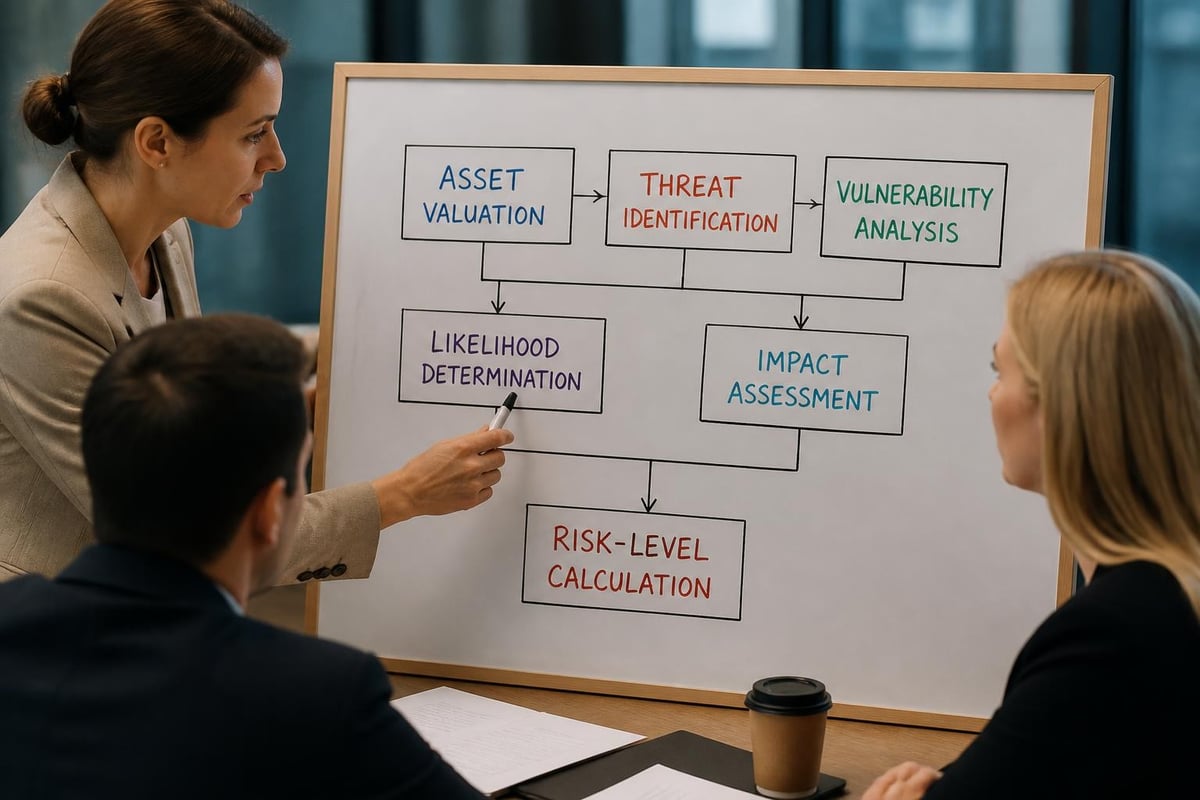
Qualitative assessments use descriptive categories (High, Medium, Low) and rely on expert judgment. They work well for organizations new to risk assessment or those without extensive historical data. Quantitative assessments assign numeric values to likelihood and impact, often estimating annual loss expectancy or other financial metrics. They provide more precise comparisons but require more data and effort.
Most practical security and risk assessment programs use a hybrid approach: quantitative analysis for high-value assets or critical decisions, qualitative methods for routine assessments, and semi-quantitative scales that assign numbers to qualitative categories for easier prioritization.
Building a Threat-Informed Assessment Process
Modern risk assessment incorporates threat intelligence to ground evaluations in real-world adversary behavior rather than theoretical vulnerabilities. The MITRE ATT&CK framework maps adversary tactics and techniques observed across thousands of incidents, providing a common language for describing how attacks unfold.
Organizations use ATT&CK to build threat scenarios based on adversaries that actually target their industry and region. A financial services firm in Australia faces different threat actors with different capabilities than a logistics company in Dubai. Threat-informed assessment focuses defenses on the techniques most likely to be used against the organization's specific assets and attack surface.
Mapping Controls to Adversary Techniques
Effective security and risk assessment evaluates not just whether controls exist but whether they address realistic attack paths. The MITRE Center for Threat-Informed Defense provides mappings between common security frameworks (NIST CSF, CIS Controls, ISO 27001) and ATT&CK techniques.
This mapping allows assessors to identify coverage gaps: techniques that adversaries commonly use but current controls do not adequately address. It also prevents over-investment in controls that address low-probability techniques irrelevant to the organization's threat landscape.
F&C helps organizations implement governance frameworks and GRC strategy that connect control selection to documented threat scenarios, ensuring that security investments address real rather than hypothetical risks.
Control effectiveness assessment examines whether deployed controls operate as intended. A firewall rule that should block external access to administrative interfaces provides no protection if misconfigured or if administrators routinely bypass it using shadow IT solutions. Assessment includes:
- Configuration testing against security baselines
- Process observation to verify operational controls
- Evidence review for detective and corrective controls
- Compensating control analysis when primary controls cannot be implemented
The CIS Controls framework provides a prioritized, threat-informed approach that groups controls into Implementation Groups based on organizational size and resources. This helps resource-constrained organizations implement foundational safeguards before pursuing advanced capabilities.
Conducting Vulnerability and Penetration Testing
Vulnerability assessment and penetration testing (VAPT) provide empirical data for security and risk assessment by actively testing whether identified vulnerabilities can be exploited. While related, these activities serve different purposes and use different methods.
Vulnerability assessment systematically identifies and classifies security weaknesses across the technology estate. Automated scanners examine networks, systems, and applications for known vulnerabilities, misconfigurations, and compliance deviations. Manual reviews assess design weaknesses, insecure workflows, and policy gaps that automated tools miss.
Penetration testing simulates adversary behavior by attempting to exploit vulnerabilities and chain techniques to achieve specific objectives (data exfiltration, privilege escalation, lateral movement). Penetration tests validate whether existing controls actually prevent or detect exploitation, providing evidence of real-world risk levels.
Organizations tailor VAPT scope based on assessment priorities. An e-commerce platform prioritizes web application testing and payment processing security. A professional services firm emphasizes email security, endpoint protection, and third-party access controls.

VAPT Methodology and Frequency
Effective VAPT programs align testing frequency with asset criticality and change velocity. Critical external-facing applications warrant quarterly testing. Internal systems on stable platforms may follow annual or biannual cycles. Major architecture changes, compliance requirements, or incident response trigger additional assessments.
Testing methodologies range from black-box assessments (minimal information provided, simulating external attackers) to white-box engagements (full documentation, credentials, and source code access). Gray-box testing provides partial information, balancing realism with comprehensive coverage.
The OWASP Cheat Sheet Series offers practical guidance for application-level risk assessment techniques, including threat modeling, secure code review, and attack-surface analysis. Organizations developing custom applications or APIs incorporate these techniques into their security and risk assessment programs.
Managed VAPT and Forensics services provide organizations access to specialized testing capabilities without building internal penetration testing teams. Assessments are scoped to business objectives, assets, and risk tolerance, with findings integrated into the broader risk management program.
Integrating Risk Assessment Into Governance Programs
Security and risk assessment provides the foundation for governance, risk, and compliance (GRC) programs by establishing the risk baseline that informs control selection, investment prioritization, and compliance verification. Isolated assessments produce reports; integrated programs drive continuous improvement.
Risk registers document identified risks, their current assessment (likelihood, impact, risk level), assigned risk owners, and planned treatments. Mature organizations track risk trends over time, measuring whether treatments reduce risk levels as expected and whether new risks emerge as the business evolves.
Treatment options fall into four categories:
- Avoid the risk by eliminating the activity or asset that creates exposure
- Reduce the risk through control implementation or process changes
- Transfer the risk via insurance, outsourcing, or contractual allocation
- Accept the risk when treatment costs exceed potential impact
Decision-makers select treatments based on cost-effectiveness, implementation feasibility, and alignment with risk appetite. A comprehensive information security risk management program documents these decisions and tracks treatment implementation.
Aligning Assessment With Compliance Frameworks
Many organizations conduct security and risk assessment to meet compliance obligations under frameworks like ISO 27001, SOC 2, PCI DSS, or regional regulations. While compliance drives initial assessment, effective programs expand beyond checkbox exercises to address business-specific risks that compliance standards may not cover.
| Framework | Assessment Focus | Key Risk Areas |
|---|---|---|
| ISO 27001 | Comprehensive ISMS risk assessment across all asset classes | Information confidentiality, integrity, availability |
| SOC 2 | Trust Services Criteria (security, availability, confidentiality, processing integrity, privacy) | Service delivery risks, outsourced processes |
| PCI DSS | Cardholder data environment security | Payment processing, card data storage and transmission |
| GDPR | Personal data processing risks | Data subject rights, cross-border transfers, breach notification |
The CISA Guide to Getting Started with a Cybersecurity Risk Assessment provides practical templates and resources for U.S. organizations, though the core methodology applies globally with local regulatory adaptations.
Organizations implementing an ISO 27001:2022 ISMS structure their security and risk assessment to meet Annex A control requirements while addressing risks specific to their operational context, industry, and geographic footprint.
Risk Assessment for Emerging Technologies
Traditional security and risk assessment methodologies require adaptation for emerging technologies that introduce novel risk patterns. Artificial intelligence systems, Internet of Things deployments, and cloud-native architectures present risk scenarios that asset-centric frameworks may not adequately address.
AI system risk assessment examines how machine learning models make decisions, what training data influences outputs, and how adversaries might manipulate inputs or poison training sets. Organizations assess risks related to bias, explainability, data privacy, and adversarial attacks alongside traditional confidentiality and availability concerns.
Risk assessment for AI begins with use case analysis: understanding what decisions the AI system makes, what data it processes, and what harms could result from incorrect outputs or compromised models. AI governance and risk management programs establish oversight mechanisms that connect technical safeguards to business accountability.
Cloud and Third-Party Risk Assessment
Cloud adoption and digital supply chains shift some organizational risks to third parties while introducing new dependencies. Security and risk assessment for cloud services evaluates:
- Shared responsibility allocation between cloud provider and customer
- Data sovereignty and cross-border transfer implications
- Vendor security practices through due diligence and compliance verification
- Integration risks at connection points between on-premises and cloud environments
- Exit and portability capabilities if the cloud relationship ends
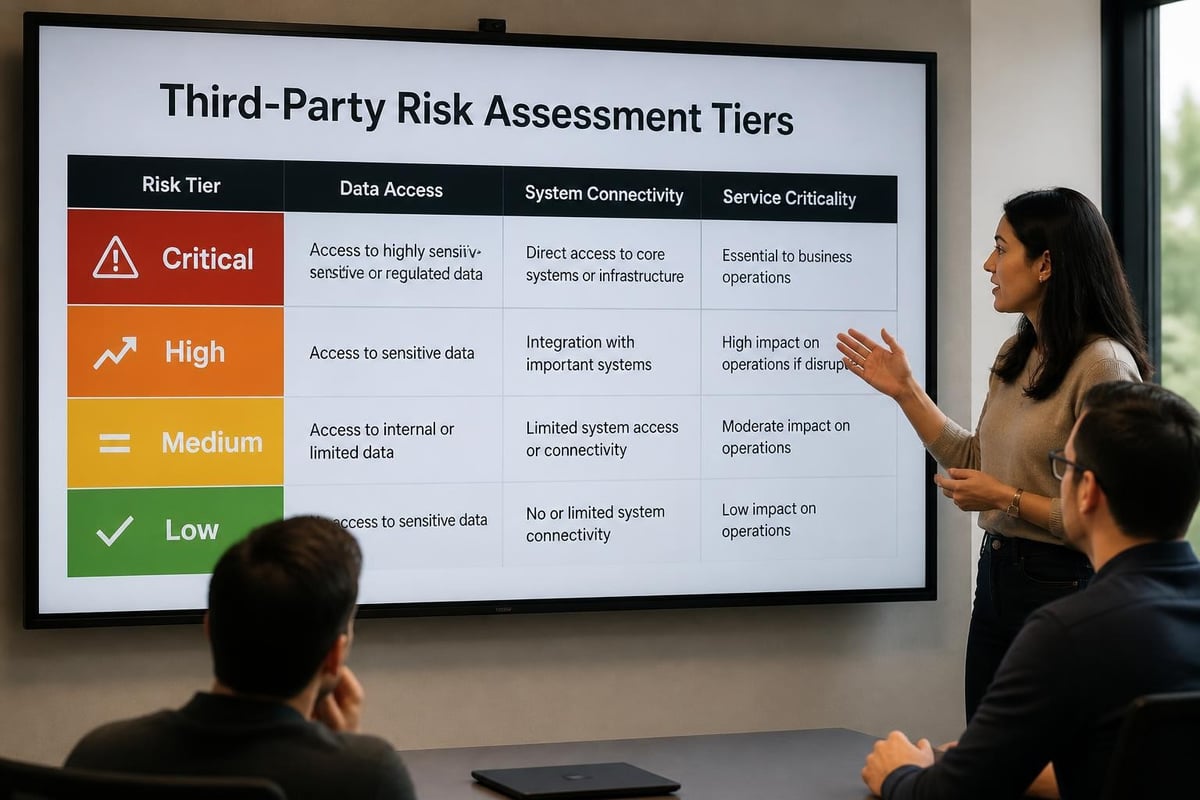
Third-party and supplier risk assessment examines vendors with access to organizational data or systems, evaluating their security maturity through questionnaires, evidence review, and on-site assessments for critical suppliers. Organizations tailor assessment depth to the criticality and scope of third-party access.
Operationalizing Risk Assessment Findings
Assessment reports that sit on shelves provide no security value. Effective programs translate findings into actionable remediation plans with clear ownership, deadlines, and success criteria. Prioritization balances risk levels with implementation cost and business impact.
Critical risks threatening core business operations or regulatory compliance receive immediate attention with executive oversight. High risks enter formal project management with assigned resources and quarterly tracking. Medium and low risks may be addressed through routine maintenance cycles or accepted with documented justification.
Risk treatment plans specify:
- Control changes required to reduce risk
- Responsible individuals and their accountability
- Implementation timeline and milestones
- Verification method to confirm effectiveness
- Residual risk level expected after treatment
Organizations establish control design and implementation processes that ensure new controls integrate with existing security architecture and operational procedures. Isolated point solutions create management complexity without proportional risk reduction.
Continuous Monitoring and Reassessment
Security and risk assessment is not a one-time project but an ongoing program that adapts to changing threats, new vulnerabilities, and evolving business operations. Organizations establish reassessment triggers:
- Scheduled cycles (annual, biannual) for comprehensive review
- Major changes to infrastructure, applications, or business processes
- Significant incidents affecting the organization or industry peers
- New threat intelligence indicating emerging attack techniques
- Regulatory updates changing compliance requirements
Continuous monitoring provides real-time risk indicators between formal assessments. Security operations teams track control effectiveness metrics, vulnerability trends, and threat intelligence to identify risk changes requiring immediate attention.
Organizations implementing compliance monitoring and reporting integrate risk indicators into executive dashboards, enabling leadership to track security posture trends and make informed resource allocation decisions.
Building Internal Risk Assessment Capability
Organizations choosing to build internal security and risk assessment programs require skilled personnel, established methodologies, and sustained executive commitment. The alternative is partnering with external specialists who provide expertise and resources on demand.
Internal programs offer continuous access to assessors who understand organizational context and can integrate assessment with daily operations. They work well for larger organizations with complex environments and regulatory obligations that justify full-time risk management staff.
External partnerships provide specialized expertise, independence, and flexibility for organizations without internal security teams. Experienced assessors bring industry insights and threat intelligence from diverse client engagements while avoiding the overhead of permanent headcount.
Many organizations adopt hybrid models: building internal capability for routine monitoring and lightweight assessments while engaging specialists for comprehensive reviews, penetration testing, and compliance preparation. F&C's managed cybersecurity and compliance services support organizations at any maturity level, from initial risk assessment through ongoing risk management program operation.
Regardless of model, effective programs share common characteristics:
- Executive sponsorship ensuring assessment findings influence decisions
- Clear methodology providing consistent, repeatable results
- Documented risk appetite guiding treatment prioritization
- Integration with business processes embedding risk consideration into change management, procurement, and project delivery
- Regular reporting keeping stakeholders informed of risk trends and treatment progress
Selecting Security and Risk Assessment Partners
Organizations evaluating external assessment providers should consider expertise, methodology alignment, and cultural fit alongside cost. The cheapest assessment often produces the least valuable results, while premium pricing does not guarantee relevant insights for your specific environment.
Professional certifications indicate baseline competency but do not replace relevant experience. Look for assessors who understand your industry's threat landscape, regulatory environment, and operational constraints. Review case studies and references from similar organizations.
Assessment scope and depth should match your objectives. Comprehensive enterprise risk assessments differ significantly from focused application testing or compliance gap analysis. Clarify deliverables, timelines, and resource requirements before engagement.
Remediation support varies across providers. Some deliver findings reports and conclude engagement. Others provide risk treatment and remediation guidance, implementation assistance, and verification testing to confirm risk reduction.
Questions to ask prospective assessment partners:
- What methodology guides your assessments, and how do you adapt it to client context?
- How do you incorporate current threat intelligence into risk scenarios?
- What credentials do your assessors hold, and what relevant experience do they bring?
- How do you prioritize findings and support remediation planning?
- What ongoing support do you provide after initial assessment?
- Can you provide references from organizations of similar size and industry?
Organizations in Australia, New Zealand, the United States, and Dubai face jurisdiction-specific compliance requirements and regional threat patterns that global assessment templates may not address. Partners with local presence and expertise provide more relevant, actionable guidance.
Security and risk assessment transforms uncertainty into informed decision-making by systematically identifying threats, evaluating vulnerabilities, and prioritizing protective investments based on realistic impact scenarios. Organizations that integrate ongoing risk assessment into governance programs build resilience that adapts as threats evolve and business operations change. F&C provides comprehensive security and risk assessment services tailored to your industry, regulatory environment, and operational context, supporting organizations without internal security teams through every phase from initial assessment to long-term risk management. Contact us to discuss how we can help you understand and manage the risks that matter most to your business.