
Cybersecurity Audit Services: A 2026 Buyer's Guide
Business leaders today face a complex landscape of cybersecurity requirements, from regulatory mandates to contractual obligations and stakeholder expectations. Cybersecurity audit services provide independent verification that your security controls actually work as intended, that your risk management approach aligns with recognized standards, and that your organization can demonstrate compliance when it matters most. For organizations without dedicated internal security teams, understanding what these services deliver and how to prepare for them is essential to protecting both operations and reputation in 2026.
What Cybersecurity Audit Services Actually Cover
Cybersecurity audit services examine your organization's security posture through structured, evidence-based assessments. These engagements evaluate whether your implemented controls meet specific requirements, whether those controls operate effectively, and whether your overall approach to managing information security risk is fit for purpose.
Core audit activities typically include:
- Review of security policies, standards, and procedures against relevant frameworks
- Testing of technical controls such as access management, encryption, and network segmentation
- Examination of operational processes including incident response, change management, and backup procedures
- Verification that security documentation reflects actual practice
- Assessment of third-party and supply chain security arrangements
Unlike vulnerability assessments or penetration testing, which focus on identifying technical weaknesses, cybersecurity audit services evaluate your entire security program. The SANS Institute overview of penetration testing clearly distinguishes these approaches: audits assess compliance and control effectiveness, while testing probes for exploitable vulnerabilities.

Common Audit Frameworks and Standards
Organizations pursue cybersecurity audits for different reasons, and the framework selected shapes the entire engagement. ISO/IEC 27001 audits verify your information security management system against international best practice. SOC 2 audits, detailed in the AICPA/CIMA resources on the SOC reporting suite, provide assurance to customers about your service organization controls. PCI DSS audits confirm payment card data protection, with the PCI Security Standards Council bulletin and SAQ guidance outlining current requirements for 2026.
Each framework demands different evidence, follows distinct testing methodologies, and produces reports suited to specific audiences. Selecting the right framework depends on your industry, your customers' requirements, and your business objectives.
| Framework | Primary Purpose | Typical Audience | Certification Available |
|---|---|---|---|
| ISO 27001 | ISMS verification | Global business partners | Yes (independent) |
| SOC 2 Type II | Service organization controls | Customers, prospects | No (report only) |
| PCI DSS | Payment card security | Card brands, acquirers | Yes (QSA audit) |
| NIST CSF | Risk management maturity | Internal, regulators | No (self/third-party) |
The framework you choose determines audit scope, duration, cost, and the value you can demonstrate to stakeholders.
Who Needs Cybersecurity Audit Services
Not every organization requires formal cybersecurity audits, but specific triggers make them necessary or highly valuable. Regulatory compliance represents the most common driver. Financial services, healthcare, and critical infrastructure sectors face mandatory audit requirements under laws specific to their jurisdictions. Organizations operating across Australia, New Zealand, the United States, and Dubai must navigate overlapping regulatory expectations that often require independent verification.
Contractual obligations trigger many audit engagements. Large enterprises and government agencies increasingly require their suppliers, service providers, and business partners to demonstrate security compliance through recognized audit reports. If you provide cloud services, process customer data, or connect to client networks, your customers likely expect SOC 2 reports or equivalent evidence.
Market differentiation drives voluntary audits as well. Achieving ISO 27001 certification or maintaining clean SOC 2 reports signals to prospective customers that you take security seriously and have invested in verifiable controls. For organizations competing for enterprise contracts, these credentials often become table stakes rather than differentiators, but their absence disqualifies you from consideration entirely.
The ISACA article on auditing and digital transformation highlights how modern businesses face audit skills gaps and need to adapt audit approaches to cloud, DevOps, and continuous delivery environments. Organizations undergoing digital transformation benefit from cybersecurity audit services that help them understand whether their security keeps pace with technology adoption.
Internal Audit vs. External Audit Requirements
Many organizations maintain internal audit management review programs that periodically examine security controls as part of governance obligations. These internal audits help identify gaps before external assessors arrive, support continual improvement, and provide management with visibility into control effectiveness.
External audits deliver independent assurance. Whether you're pursuing certification, satisfying customer requirements, or meeting regulatory mandates, external auditors provide the credibility that internal assessments cannot match. Third-party auditors have no stake in your organization's operations and follow standardized methodologies that produce comparable, trustworthy results.
How to Prepare for a Cybersecurity Audit
Preparation determines audit outcomes more than any other factor. Organizations that approach audits reactively, scrambling to gather evidence and implement missing controls during the assessment window, face extended timelines, inflated costs, and frequent findings. Those that prepare systematically experience smoother engagements and stronger results.
Start by understanding your scope. Which systems, processes, and organizational units fall within the audit boundary? Which framework or standard applies? What evidence will auditors expect? Clear scoping prevents misunderstandings and ensures you prepare the right materials.
Governance frameworks and GRC strategy establish the foundation for successful audits. Your policies must define security objectives, assign responsibilities, and establish processes that actually operate in practice. Auditors examine whether your documented approach matches reality.
Building Your Evidence Portfolio
Cybersecurity audit services rely on evidence. Auditors verify claims by examining documents, observing processes, interviewing personnel, and testing controls. The CISA Vulnerability and Assessment program overview demonstrates how federal assessors structure evidence collection, offering insights applicable to commercial audits.
Essential evidence categories include:
- Policy and procedure documentation that defines your security program
- Configuration evidence showing how systems are actually configured
- Access control records demonstrating who has access to what
- Change records proving you manage system modifications
- Incident logs showing how you detect and respond to security events
- Training records confirming security awareness efforts
- Vendor assessments documenting third-party risk management
Organizations benefit from maintaining evidence and audit readiness capabilities year-round rather than assembling materials on demand. Continuous evidence collection reduces audit preparation burdens and enables you to demonstrate consistent control operation.
Many businesses find that gap assessments and remediation services before formal audits identify weaknesses early and provide time to address them. Pre-audit assessments cost less than audit findings and improve certification likelihood.
The Cybersecurity Audit Process Step by Step
Understanding how cybersecurity audit services actually unfold helps you set realistic expectations and allocate appropriate resources. While specific frameworks introduce variations, most audits follow a consistent pattern from planning through reporting.
Phase 1: Planning and Scoping begins weeks before on-site activities. Auditors work with you to define boundaries, identify key personnel, understand your technology environment, and establish the assessment timeline. You'll provide preliminary documentation, including policies, network diagrams, and system inventories. This phase sets expectations and prevents surprises.
Phase 2: Documentation Review involves auditors examining your security policies, standards, procedures, and supporting materials. They verify that your documented approach addresses all framework requirements and that your documentation is current, approved, and distributed to relevant staff. Gaps identified during documentation review often require remediation before testing proceeds.
Phase 3: Control Testing represents the core audit activity. Auditors select samples of transactions, configurations, access grants, and operational processes to verify that controls operate as documented. They interview personnel, observe processes in action, and examine system configurations and logs. Testing methodologies vary by framework, but all involve evidence-based verification.
The Institute of Internal Auditors guidance on auditing cyber incident response illustrates how auditors structure testing for specific security domains, providing useful context for understanding audit depth.
Findings, Remediation, and Reporting
Phase 4: Findings Communication occurs as auditors discover gaps between requirements and implementation. Minor findings might require documentation updates, while major findings indicate control failures that must be addressed before certification or report issuance. Auditors typically share preliminary findings before finalizing reports, allowing you to respond or provide additional evidence.
Phase 5: Remediation involves addressing identified gaps. Depending on framework and auditor requirements, you may need to implement corrective actions before report issuance or document remediation plans for post-audit completion. Effective remediation requires understanding root causes rather than applying superficial fixes.
Phase 6: Report Issuance concludes the engagement. Audit reports detail scope, methodology, findings, and conclusions. For certification audits, successful completion results in certificates valid for defined periods. For SOC reports, auditors issue formal opinions on control design and operating effectiveness. These reports serve as evidence for customers, regulators, and other stakeholders.

Selecting Cybersecurity Audit Service Providers
Choosing the right audit provider significantly impacts engagement quality, cost, and business value. Not all auditors bring equivalent expertise, and the cheapest option rarely delivers optimal results. Business leaders should evaluate potential providers against several criteria before committing to multi-year relationships.
Accreditation and qualifications matter. For ISO 27001 audits, your auditor must be accredited by a recognized certification body. For SOC 2 engagements, auditors should be licensed CPAs with relevant security experience. For PCI DSS, only Qualified Security Assessors can perform certain audit types. Verify credentials before engagement.
Industry experience influences audit quality substantially. Auditors familiar with your sector understand relevant risks, common control patterns, and regulatory context. They ask better questions, recognize genuine controls from checkbox compliance, and provide more valuable recommendations. Generic auditors miss nuances that industry specialists catch.
Evaluate service approach and flexibility. Some audit firms operate rigidly, applying checklists without considering your business context. Others take consultative approaches, helping you understand requirements and build sustainable programs. For organizations without internal security teams, auditors who explain findings and support remediation provide more value than those who simply identify gaps.
Organizations managing compliance and regulatory assessments across multiple frameworks benefit from providers who understand how different requirements overlap and can identify efficiency opportunities. Single audits can sometimes satisfy multiple frameworks when scoped properly.
Ongoing Compliance vs. Point-in-Time Audits
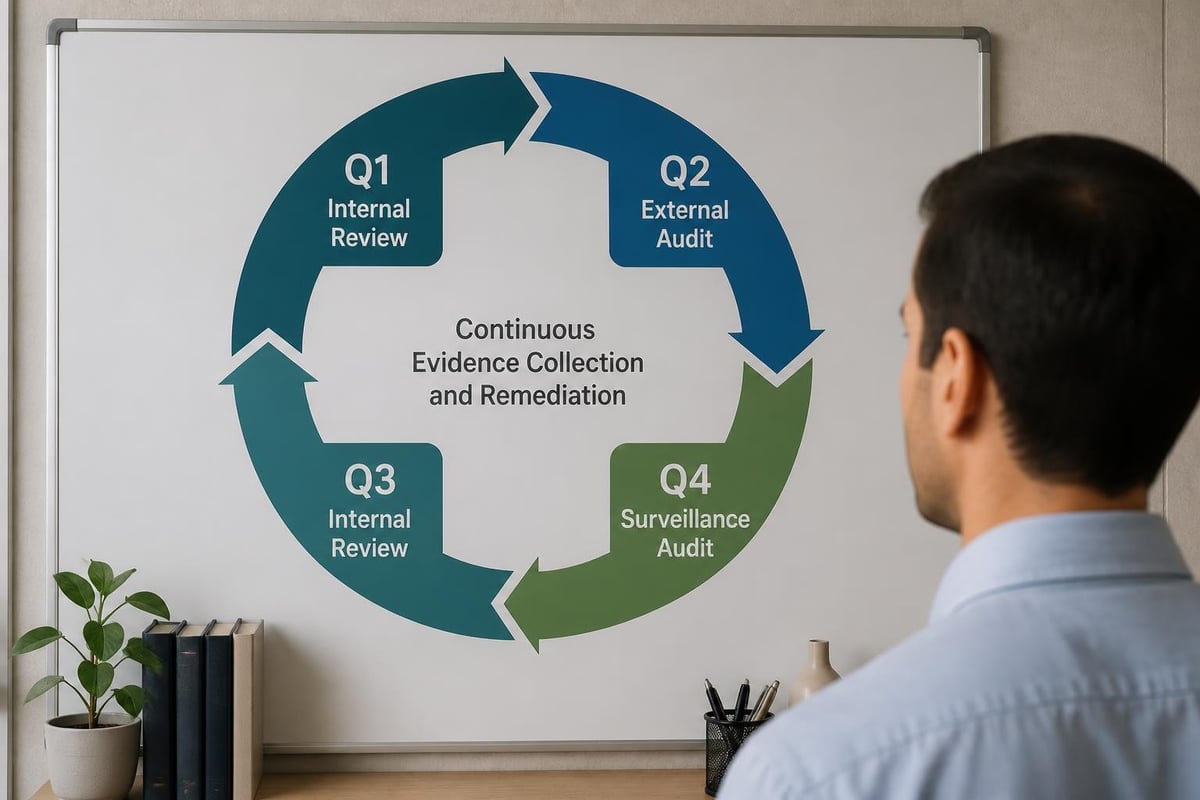
A common misconception treats cybersecurity audits as one-time events rather than components of continuous compliance programs. Point-in-time audits verify control effectiveness on specific dates, but security operates continuously. Threats evolve, systems change, and controls drift from documented states between formal assessments.
Surveillance audits and recertification maintain certifications beyond initial achievement. ISO 27001 requires annual surveillance audits and triennial recertification. SOC 2 Type II reports cover defined periods (typically six to twelve months) and require annual renewal. These ongoing assessments verify that you maintain controls consistently rather than implementing them temporarily for audit purposes.
Compliance monitoring and reporting capabilities help organizations track control effectiveness between formal audits. Automated monitoring, periodic self-assessments, and management reviews identify drift early and support remediation before external auditors discover gaps.
The shift toward continuous auditing reflects modern business reality. The ISACA perspectives on auditing in digital transformation discuss how audit frequency and methodology must adapt to DevOps, cloud, and agile environments where change occurs daily rather than quarterly.
Consider these ongoing compliance elements:
- Quarterly internal control testing to identify gaps early
- Continuous evidence collection rather than pre-audit scrambles
- Regular policy and procedure reviews to maintain currency
- Periodic risk assessments reflecting technology and threat changes
- Documented management reviews demonstrating oversight
Organizations that embed these practices into operations maintain stronger security postures and experience less disruptive formal audits.
Cost Factors and Budgeting for Audits
Cybersecurity audit services represent significant investments, and understanding cost drivers helps you budget appropriately. Audit costs vary widely based on organization size, scope complexity, framework selected, and provider rates. Small businesses pursuing ISO 27001 certification might spend between USD 15,000 and 30,000 annually including surveillance, while enterprise SOC 2 Type II audits can exceed USD 100,000 depending on scope.
| Cost Driver | Impact on Audit Price | Strategies to Manage |
|---|---|---|
| Scope breadth | Direct (more systems = more cost) | Define minimum viable scope |
| Control maturity | Inverse (mature controls audit faster) | Invest in readiness before audit |
| Documentation quality | Inverse (good docs reduce time) | Maintain evidence continuously |
| Framework complexity | Direct (complex = more testing) | Align framework to actual needs |
| Provider experience | Variable (expertise costs more, saves time) | Balance cost with quality |
Beyond direct audit fees, factor in internal resource costs. Your staff will spend significant time supporting auditors: gathering evidence, participating in interviews, demonstrating processes, and addressing findings. Organizations without dedicated compliance personnel often underestimate these internal costs.
Remediation costs frequently exceed audit fees. If audits reveal significant control gaps, implementing corrective actions-new technologies, process changes, additional personnel-can dwarf assessment costs. This makes pre-audit readiness investments economically rational. Spending USD 10,000 on gap assessments and remediation before a USD 25,000 audit makes more sense than discovering USD 50,000 in remediation during the engagement.
Integrating Audits with Broader Security Programs
Cybersecurity audit services deliver maximum value when integrated with comprehensive security programs rather than treated as isolated compliance exercises. Audits verify that your security investments work as intended, but they don't replace proactive security management, threat detection, or incident response capabilities.
Organizations benefit from aligning audit preparation with information security risk management processes. Risk assessments identify what matters most to protect, and audit scopes should prioritize high-risk areas. This alignment ensures audits verify controls protecting your most critical assets rather than checking generic boxes.
Technical security services complement audit programs. While audits assess whether you have vulnerability management processes, managed VAPT and forensics services actually identify and help remediate vulnerabilities in your systems. Vulnerability assessment and penetration testing examine weaknesses in authorized systems, with each workstream scoped separately to your objectives, assets, and tests, tailored to your business context.
Supply chain security represents another integration point. The NIST Special Publication on cybersecurity supply chain risk management provides practical guidance for auditing third-party and software supply chain risks relevant in 2026. Audit programs should verify that you assess vendor risks, monitor supplier security, and maintain appropriate contractual protections.
Audit findings should feed continual improvement programs rather than collecting dust in reports. Organizations that treat audit results as learning opportunities build stronger security over time. Those that view audits as hurdles to clear waste the investment and miss improvement opportunities.
Preparing Your Team for Audit Success
People make or break audit engagements. Even organizations with strong technical controls struggle when staff don't understand their security responsibilities or can't articulate how controls operate. Preparing your team for cybersecurity audit services requires both training and clear communication about expectations.
Personnel should understand:
- Why the audit matters to the organization
- What their specific roles involve during the assessment
- How to find and present evidence effectively
- What auditors will ask and how to respond accurately
- Where to direct questions they can't answer themselves
Security awareness training supports audit readiness by ensuring staff understand policies and procedures they'll be asked to demonstrate. Auditors frequently interview personnel at various levels to verify that documented processes reflect actual practice and that security awareness extends beyond the IT department.
Designating an audit coordinator provides auditors with a central contact who can arrange interviews, locate evidence, and resolve questions efficiently. This role requires someone who understands your security program, knows where documentation lives, and can communicate effectively with both technical staff and auditors.
Practice sessions help teams perform better under actual audit conditions. Conducting mock interviews, practicing evidence retrieval, and walking through processes before auditors arrive builds confidence and reveals gaps in your preparation.
Common Audit Findings and How to Avoid Them
Cybersecurity audit services consistently identify similar issues across organizations and industries. Understanding common findings helps you address likely gaps before auditors discover them, reducing assessment friction and improving outcomes.
Access management tops the finding list. Auditors frequently discover:
- User accounts that should have been terminated remaining active
- Excessive privileges granted based on convenience rather than need
- Shared accounts or generic credentials in use
- Inadequate review of access rights
- Missing documentation of access approval processes
Implementing regular access reviews, automating account lifecycle management, and documenting approval workflows address these findings proactively. Review case studies to see how organizations have tackled access control challenges during certification preparation.
Change management represents another frequent finding area. Organizations implement changes to production systems without proper testing, approval, or documentation. Auditors verify that you control changes to prevent unauthorized modifications and maintain system integrity. Documented change processes with approval records and backout plans satisfy these requirements.
Incomplete documentation creates numerous findings. Policies exist but aren't current. Procedures describe outdated processes. Evidence can't be located when auditors request it. Maintaining policies, standards, and procedures as living documents rather than shelf-ware prevents these issues.
Third-party risk management findings appear increasingly common. The NIST guidance on supply chain risk management reflects growing emphasis on vendor security. Organizations must assess vendor risks, obtain security commitments contractually, and monitor supplier compliance. Simple vendor lists without risk assessments generate findings.
Cybersecurity audit services verify that your security investments deliver real protection and that your organization can demonstrate compliance when stakeholders demand evidence. Success requires understanding audit frameworks, preparing systematically, maintaining evidence continuously, and integrating audits with broader security programs. F&C provides the expertise to help you prepare for audits, address findings, and build sustainable compliance programs tailored to your business context. Contact F&C to discuss how we can support your audit readiness and long-term security objectives.