
Governance Compliance: Essential Framework for 2026
Organizations across Australia, New Zealand, the United States, and Dubai face increasing pressure to demonstrate effective governance compliance as regulatory expectations evolve and cyber threats intensify. Whether you're managing financial data, customer information, or critical infrastructure, governance compliance provides the structured oversight needed to align business objectives with security requirements, regulatory mandates, and stakeholder expectations. For decision-makers without dedicated security teams, understanding how governance compliance operates and what implementation requires becomes essential for long-term resilience and competitive advantage.
Understanding Governance Compliance Fundamentals
Governance compliance establishes the framework through which organizations manage information security, regulatory obligations, and operational risk. Unlike isolated compliance activities that address single regulations, governance compliance integrates oversight mechanisms, accountability structures, and control environments into a cohesive management system.
At its core, governance compliance answers three fundamental questions: who makes decisions, how those decisions align with legal and regulatory requirements, and what evidence demonstrates effective oversight. The ISO/IEC 38500:2024 standard provides an international benchmark for IT governance, establishing principles that connect board-level responsibility to operational execution.
Key Components of Governance Compliance Programs
Effective governance compliance programs typically include these elements:
- Governance framework defining roles, responsibilities, and decision-making authority
- Policy architecture establishing security and compliance requirements across the organization
- Risk management processes identifying, assessing, and treating information security risks
- Control implementation translating policy requirements into operational safeguards
- Monitoring and reporting providing visibility into compliance status and risk exposure
- Continual improvement adapting governance and controls as threats and regulations evolve
Organizations implementing governance frameworks often begin with governance frameworks and GRC strategy to establish the foundation before layering specific compliance requirements and controls.

Regulatory Drivers and Compliance Obligations
Governance compliance requirements vary by industry, jurisdiction, and organizational activities. Financial services organizations face different mandates than healthcare providers, while multinational operations must address overlapping regulatory regimes.
Common regulatory frameworks driving governance compliance in 2026 include privacy regulations like GDPR and Australia's Privacy Act, sector-specific requirements such as PCI DSS for payment card processing, and cybersecurity frameworks including the NIST Cybersecurity Framework that provides structured guidance for managing cybersecurity risk. The European Data Protection Board offers detailed guidance on GDPR compliance that influences global privacy practices.
Mapping Regulations to Governance Requirements
| Regulatory Domain | Governance Focus | Typical Requirements |
|---|---|---|
| Data Protection | Privacy governance, data processing oversight | Lawful basis, data subject rights, cross-border transfers |
| Financial Services | Operational resilience, third-party risk | Control frameworks, incident reporting, audit trails |
| Healthcare | Patient data security, access controls | Encryption, authentication, breach notification |
| Critical Infrastructure | Cybersecurity maturity, incident response | Threat detection, recovery capabilities, government reporting |
Organizations operating across multiple jurisdictions benefit from establishing comprehensive compliance regulatory assessments that identify applicable requirements and map them to existing controls, reducing duplication while ensuring coverage.
Implementing Effective Governance Structures
Successful governance compliance begins with clear accountability. Boards and executive leadership must understand their oversight responsibilities, while operational teams need authority and resources to implement requirements effectively.
Governance structures typically include:
- Board or committee oversight setting risk appetite, approving policies, and reviewing compliance status
- Executive sponsorship providing resources and removing organizational barriers
- Governance office or function coordinating compliance activities and reporting
- Subject matter experts implementing controls within their domains
- Internal audit providing independent assurance over governance effectiveness
Many organizations struggle with defining roles, responsibilities, and accountability across these layers, particularly when security expertise resides outside the organization. Managed service partnerships can extend governance capabilities without requiring full-time internal resources.
Establishing Policy and Standard Frameworks
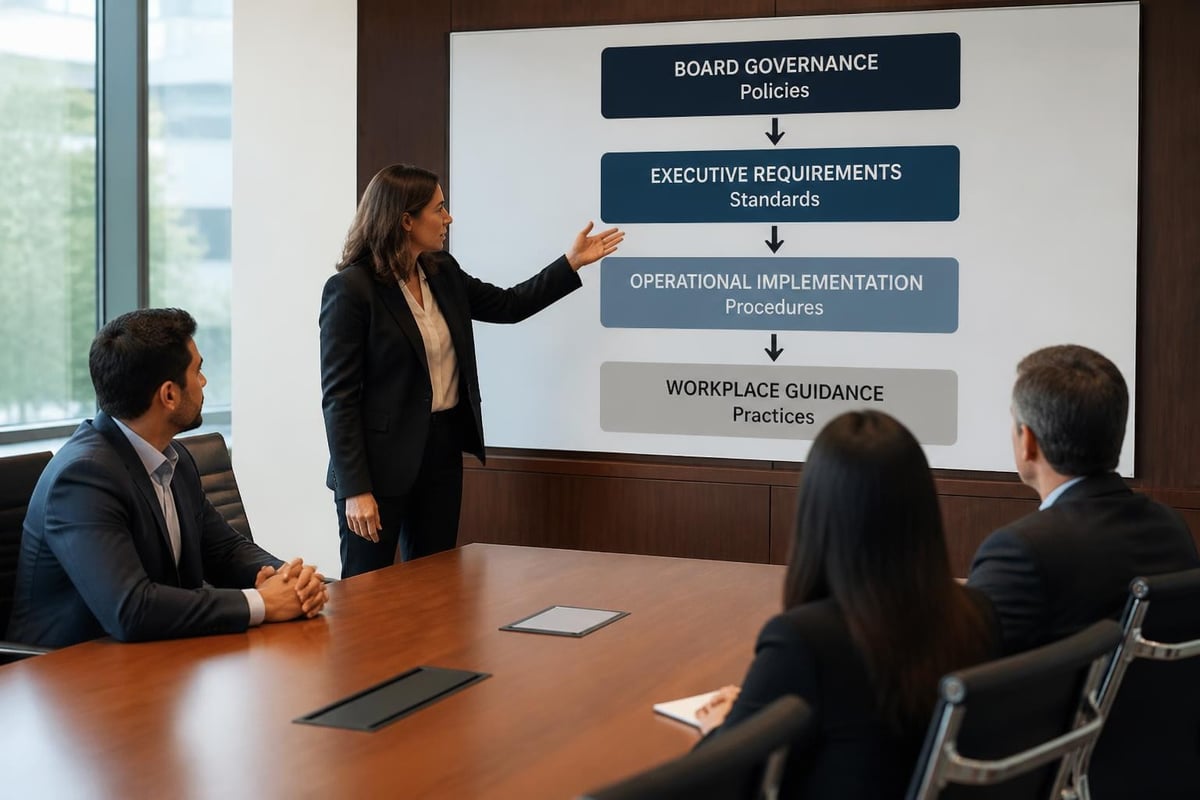
Policy frameworks translate governance principles into actionable requirements. Effective policies, standards, and procedures create a hierarchy from high-level statements to specific implementation guidance.
A typical three-tier structure includes:
- Policies articulating mandatory requirements and organizational positions
- Standards specifying technical and procedural baselines
- Procedures providing step-by-step implementation guidance
This structure allows organizations to maintain stable policy positions while updating standards and procedures as technology and threats evolve. Policy frameworks should reference applicable regulations, identify responsible parties, and specify review cycles to ensure they remain current.
Risk Management and Control Implementation
Governance compliance without effective risk management becomes a paper exercise that fails to protect the organization. Risk management processes identify threats to information assets, assess their likelihood and impact, and determine appropriate treatment strategies.
The COSO Enterprise Risk Management framework provides foundational guidance connecting risk governance to organizational objectives, while information security risk management applies these principles to technology and data environments. Organizations implementing information security risk management programs typically follow a structured methodology:
- Asset identification cataloging information assets and their business value
- Threat and vulnerability assessment determining what could go wrong and how
- Risk analysis calculating likelihood and impact to prioritize treatment
- Control selection identifying safeguards that reduce risk to acceptable levels
- Residual risk acceptance documenting risk decisions and obtaining appropriate approval
Translating Risk Requirements to Controls
Control implementation bridges governance requirements and operational reality. Controls may be technical (encryption, access controls, logging), procedural (change management, incident response), or administrative (background checks, training, segregation of duties).
Effective control design and implementation considers several factors:
- Regulatory and contractual obligations requiring specific safeguards
- Risk assessment results identifying vulnerabilities requiring mitigation
- Operational constraints affecting feasibility and cost
- Integration with existing technology and business processes
- Measurability enabling ongoing monitoring and assurance
Organizations increasingly rely on frameworks like ISO 27001 to structure control implementation. An ISO 27001:2022 ISMS Implementation provides a systematic approach to selecting and implementing controls based on risk assessment results and compliance obligations.
F&C helps organizations connect governance requirements to practical control implementations through structured ISMS programs that integrate regulatory compliance, risk management, and operational security into a unified management system.
Monitoring, Reporting, and Assurance
Governance compliance requires ongoing evidence that controls operate effectively and risks remain within acceptable boundaries. Compliance monitoring and reporting mechanisms provide this visibility to stakeholders at all levels.
Building Compliance Monitoring Programs
Effective monitoring combines multiple evidence sources:
| Monitoring Activity | Evidence Generated | Frequency |
|---|---|---|
| Automated control testing | Log analysis, configuration scans | Continuous or daily |
| Manual control reviews | Control self-assessments, walkthroughs | Monthly or quarterly |
| Vulnerability assessments | Technical findings, remediation tracking | Quarterly or event-driven |
| Internal audits | Audit reports, management responses | Annual or semi-annual |
| Independent assessments | Certification audits, penetration tests | Annual or as required |
Organizations often struggle with evidence and audit readiness because documentation requirements differ across regulations and standards. Centralized evidence repositories and standardized control testing reduce burden while improving assurance quality.
Reporting mechanisms should align with governance structures. Board-level reporting focuses on strategic risk and compliance trends, executive reporting addresses program performance and resource needs, while operational reporting tracks specific control status and remediation activities.
Cloud Governance and Shared Responsibility
Cloud adoption fundamentally changes governance compliance because responsibility distributes across multiple parties. The Cloud Security Alliance Security Guidance v5 provides comprehensive direction for cloud governance, emphasizing that compliance obligations remain with data controllers even when infrastructure operates in cloud environments.
Shared responsibility models vary by service type:
- Infrastructure-as-a-Service (IaaS) places security responsibility primarily on customers, with providers securing physical infrastructure and virtualization layers
- Platform-as-a-Service (PaaS) shifts some security responsibility to providers, particularly for operating systems and middleware
- Software-as-a-Service (SaaS) concentrates responsibility on providers for application and infrastructure security, while customers retain data governance and access management
Effective cloud governance compliance requires mapping specific obligations to responsible parties, verifying provider controls through certifications and assessments, and implementing compensating controls where provider capabilities don't fully satisfy requirements. Organizations should evaluate third-party and supplier risk for all cloud providers handling sensitive information.
Measuring Governance Compliance Effectiveness
Beyond regulatory box-checking, governance compliance should demonstrably reduce risk and support business objectives. Measurement approaches include compliance metrics (percentage of controls implemented, audit findings resolved), risk metrics (vulnerabilities identified and remediated, incident frequency and impact), and business metrics (regulatory penalties avoided, customer trust maintained).
Control effectiveness assessment provides structured evaluation of whether implemented controls achieve intended outcomes. Testing methodologies range from design reviews confirming controls exist as documented, to operating effectiveness testing demonstrating consistent performance over time.
Continual Improvement and Maturity Advancement
Governance compliance maturity evolves through several stages:
- Reactive addressing compliance requirements as they arise without structured approach
- Repeatable implementing consistent processes for known requirements
- Defined establishing organization-wide standards and governance frameworks
- Managed measuring control performance and adjusting based on results
- Optimized anticipating emerging requirements and continuously improving effectiveness
Organizations advance maturity through continual improvement programs that identify gaps, implement enhancements, and verify results. Maturity assessments provide baseline understanding and roadmap development for progression.
Regular gap assessments and remediation cycles ensure governance compliance keeps pace with regulatory changes, business evolution, and emerging threats. These assessments compare current state against requirements, prioritize findings based on risk and compliance impact, and track remediation through completion.
Emerging Governance Compliance Challenges
Several trends reshape governance compliance requirements in 2026. Artificial intelligence introduces new risks requiring AI governance and risk management approaches that address algorithmic bias, transparency, and automated decision-making oversight. Privacy regulations increasingly mandate privacy-by-design and default, requiring governance integration from project initiation rather than compliance retrofitting.
Supply chain attacks demonstrate that organizational security depends on third-party governance compliance. Regulatory expectations for supplier oversight intensify, particularly for critical service providers and those handling sensitive information. Organizations must extend governance compliance visibility beyond organizational boundaries to assess and monitor supplier controls.
Remote work and distributed operations challenge traditional governance assumptions:
- Perimeter-based controls give way to zero-trust architectures
- Endpoint management extends beyond corporate offices to homes and mobile locations
- Access control and authentication become more complex with diverse connectivity scenarios
- Monitoring and logging must accommodate cloud services and remote access
These challenges require governance frameworks that remain technology-agnostic while ensuring requirements translate effectively to modern architectures. Organizations can explore comprehensive managed cybersecurity approaches that integrate governance compliance with operational security capabilities.
Practical Steps for Governance Compliance Implementation
Decision-makers evaluating governance compliance programs should consider these implementation phases:
Phase 1: Foundation
- Identify applicable regulations and compliance obligations
- Define governance structure and assign accountability
- Establish baseline policies and risk management approach
Phase 2: Control Implementation
- Conduct risk assessment identifying treatment requirements
- Design and implement controls addressing priority risks
- Document procedures and train personnel on compliance requirements
Phase 3: Monitoring and Assurance
- Implement compliance monitoring and evidence collection
- Conduct internal reviews validating control effectiveness
- Prepare for external audits or certifications if required
Phase 4: Optimization
- Analyze compliance metrics and control performance
- Identify improvement opportunities and emerging requirements
- Adapt governance framework to organizational and threat landscape changes
Organizations without internal security expertise can accelerate implementation through managed cybersecurity partnerships that provide governance consulting, control implementation support, and ongoing compliance monitoring. This approach allows organizations to benefit from specialized expertise without building full internal teams.
Successful governance compliance ultimately depends on treating it as an ongoing management discipline rather than a one-time project. Regular reviews, stakeholder engagement, and adaptation to changing requirements ensure governance compliance continues protecting organizational objectives while satisfying regulatory expectations.
Governance compliance provides the structured oversight connecting regulatory obligations, risk management, and operational security into unified organizational practice. For businesses without dedicated security teams, establishing effective governance compliance can seem overwhelming, but structured implementation and expert support make it achievable. F&C specializes in helping organizations across Australia, New Zealand, the US, and Dubai build governance compliance programs tailored to their regulatory environment and business objectives. Our managed approach delivers the expertise, frameworks, and ongoing support needed to maintain compliance while building long-term resilience. Contact us to discuss how we can support your governance compliance requirements and security objectives.