Information Security and Risk Management in 2026
Organizations today face an evolving landscape of cyber threats that demand a structured, disciplined approach to protecting critical assets and maintaining operational continuity. Information security and risk management has emerged as the cornerstone practice that enables businesses to identify vulnerabilities, prioritize protective measures, and allocate resources effectively while maintaining compliance with regulatory obligations. This integrated discipline combines technical controls, governance frameworks, and ongoing assessment processes to create resilient security postures that adapt to emerging threats. Understanding how to implement and maintain effective information security and risk management programs separates organizations that merely respond to incidents from those that proactively prevent them.
Understanding the Foundation of Risk-Based Security
Information security and risk management begins with a fundamental shift in perspective: moving from attempting to protect everything equally to understanding what matters most and where vulnerabilities create the greatest exposure. This risk-based approach acknowledges that resources remain finite while threats continue to multiply.
Core Components of Risk Assessment
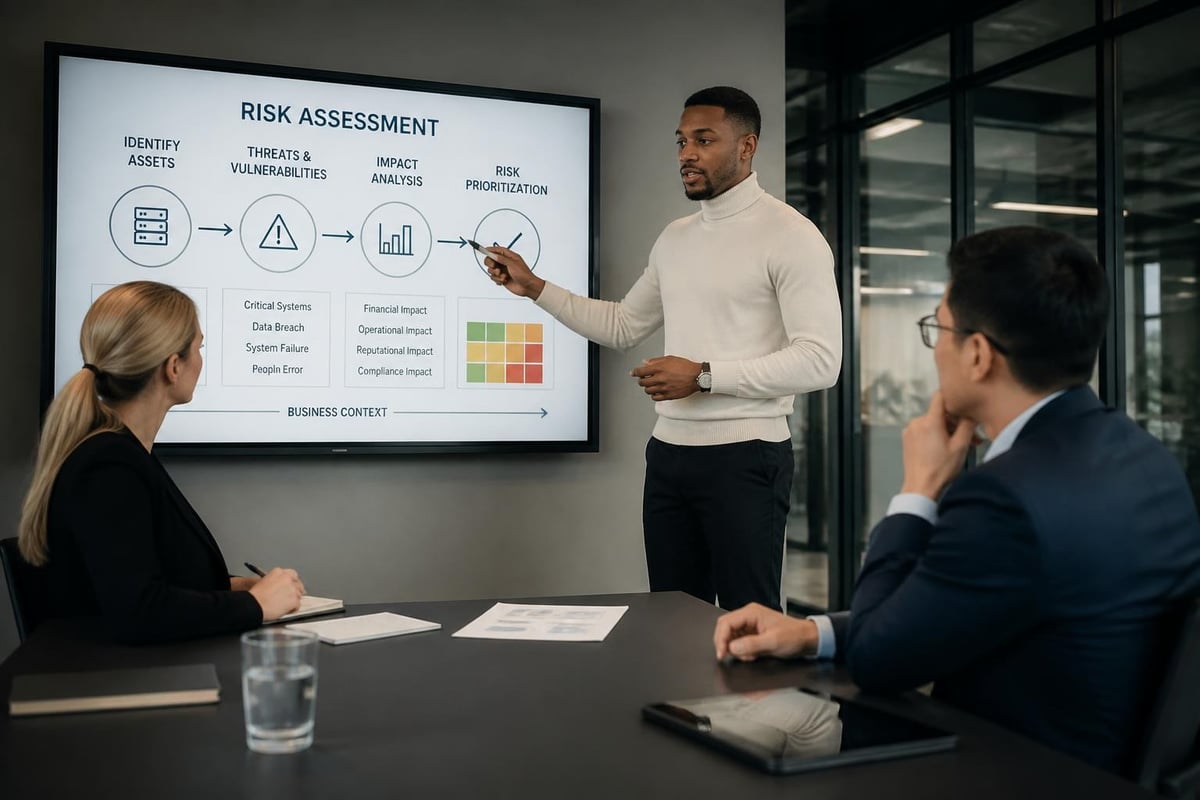
A comprehensive risk assessment framework examines three critical dimensions: asset value, threat likelihood, and vulnerability severity. Organizations must catalog their information assets, from customer data and intellectual property to operational systems and third-party integrations. Each asset receives valuation based on its importance to business operations and the potential impact of compromise.
Key elements include:
- Asset identification and classification based on confidentiality, integrity, and availability requirements
- Threat modeling that considers both external adversaries and insider risks
- Vulnerability analysis through technical testing and process review
- Impact assessment that quantifies financial, operational, and reputational consequences
- Risk calculation that combines likelihood and impact to prioritize treatment
The Center for Internet Security (CIS) Controls provides a prioritized framework that helps organizations implement foundational safeguards before advancing to more sophisticated measures. This tiered approach ensures that basic hygiene receives attention before investing in advanced capabilities.
Risk Treatment Strategies and Decision Frameworks
Once risks are identified and evaluated, organizations face four fundamental treatment options. Risk acceptance acknowledges certain exposures as acceptable within the business's risk appetite. Risk mitigation implements controls to reduce likelihood or impact to acceptable levels. Risk transfer shifts responsibility through insurance or contractual agreements. Risk avoidance eliminates the activity or asset that creates exposure.
Effective decision-making requires clear governance structures and defined risk appetite statements. Leadership must articulate how much risk the organization will tolerate in pursuit of business objectives, creating boundaries that guide security investments and operational decisions.
Building Effective Information Security Management Systems
Information security and risk management achieves practical expression through structured management systems that integrate policies, processes, and technical controls into cohesive programs. These systems provide repeatable, auditable methods for maintaining security posture over time.
Framework Selection and Implementation
Organizations implementing information security and risk management programs typically align with recognized frameworks that provide proven methodologies and external validation opportunities. The ISO/IEC 27001 standard represents the most widely adopted framework, offering a process-driven approach centered on continuous improvement.
| Framework | Primary Focus | Key Benefit | Best Suited For |
|---|---|---|---|
| ISO 27001 | ISMS certification | International recognition | Organizations seeking formal certification |
| NIST CSF | Critical infrastructure | Comprehensive, flexible | U.S.-focused or complex environments |
| CIS Controls | Practical implementation | Prioritized, actionable | Resource-constrained teams |
| COBIT | IT governance integration | Business alignment | Enterprise-wide governance programs |
Organizations often benefit from ISO 27001:2022 ISMS Implementation support that aligns security objectives with business requirements and prepares teams for independent assessment. A structured implementation approach establishes the documentation, controls, and evidence collection processes necessary for long-term program success.
The MITRE ATT&CK resources complement framework implementation by providing detailed intelligence on adversary tactics and techniques, enabling organizations to design controls that address real-world attack patterns rather than theoretical vulnerabilities.
Policy, Standard, and Procedure Development
Effective information security and risk management requires clear documentation that translates high-level objectives into operational guidance. Policies establish organizational commitments and leadership expectations. Standards define specific requirements and technical specifications. Procedures provide step-by-step instructions for executing security activities.
This documentation hierarchy ensures consistency across teams while enabling adaptation to different operational contexts. Policies, standards, and procedures must remain accessible, regularly reviewed, and enforced through accountability mechanisms.
Operational Risk Management Practices
Information security and risk management extends beyond initial implementation to encompass ongoing operational activities that maintain and improve security posture over time. These practices create the operational rhythm necessary for sustained resilience.
Continuous Monitoring and Assessment
Static security assessments provide snapshots of vulnerability at specific moments, but threats evolve continuously. Modern information security and risk management programs implement continuous monitoring that tracks security metrics, identifies anomalies, and validates control effectiveness in real time.
Monitoring priorities include:
- Security event correlation across network, endpoint, and application layers
- Vulnerability management with regular scanning and patch verification
- Compliance tracking against regulatory and framework requirements
- Threat intelligence integration to understand emerging attack vectors
- User behavior analytics to detect potential insider threats or compromised credentials
Organizations increasingly recognize that cyber resilience requires planning for inevitable incidents rather than assuming prevention alone suffices. This perspective shifts focus toward detection speed, response capability, and recovery planning as essential components of information security and risk management.
Third-Party and Supply Chain Risk
Modern business operations depend on complex networks of vendors, partners, and service providers, each introducing potential security exposures. Information security and risk management must extend beyond organizational boundaries to assess and manage these external dependencies.
Third-party risk assessment examines vendor security postures, contractual obligations, data handling practices, and incident response capabilities. Organizations implementing third-party supplier risk programs establish tiered assessment approaches based on access levels and data sensitivity.
Critical considerations include:
- Security questionnaires and independent assessments for high-risk vendors
- Contractual security requirements and right-to-audit clauses
- Ongoing monitoring of vendor security posture changes
- Incident notification and breach response procedures
- Exit planning to ensure data protection during vendor transitions

Integrating Threat Intelligence and Vulnerability Management
Information security and risk management gains precision through integration of external threat intelligence with internal vulnerability data. This combination enables organizations to prioritize remediation based on actual threat actor activity rather than generic severity scores.
Vulnerability Assessment and Penetration Testing
Regular technical testing validates that theoretical controls function as intended under adversarial conditions. Vulnerability assessments identify known weaknesses through automated scanning, while penetration testing simulates attacker behavior to discover exploitable combinations of vulnerabilities and misconfigurations.
Organizations benefit from managed VAPT and forensics programs that tailor testing to specific business assets and operational constraints. These programs provide actionable findings with clear remediation guidance rather than overwhelming teams with context-free vulnerability lists.
Application Security and Development Integration
Application vulnerabilities represent persistent attack vectors that require specialized attention within information security and risk management programs. The OWASP Top 10 provides essential guidance for identifying and addressing the most critical application security risks, from injection attacks to insecure design patterns.
Integrating security into development lifecycles through DevSecOps practices shifts vulnerability identification earlier in the process, reducing remediation costs and time-to-market impacts. Automated security testing, code analysis, and dependency scanning become routine components of build pipelines rather than afterthoughts.
Compliance, Governance, and Regulatory Alignment
Information security and risk management intersects directly with compliance obligations across industries and jurisdictions. Regulatory requirements ranging from data protection laws to sector-specific mandates create minimum security baselines that inform risk treatment decisions.
Regulatory Landscape Navigation
Organizations operating across multiple jurisdictions face complex compliance matrices. The European Union's GDPR, California's CCPA, Australia's Privacy Act, and industry frameworks like PCI DSS each impose specific security and risk management requirements.
Effective compliance strategies map regulatory obligations to existing controls, identifying gaps and overlaps that inform efficient implementation. Governance frameworks and GRC strategy services help organizations design integrated approaches that satisfy multiple requirements through unified control sets.
| Regulation | Primary Focus | Key Security Requirement | Geographic Scope |
|---|---|---|---|
| GDPR | Personal data protection | Privacy by design, breach notification | EU and EU data subjects |
| CCPA/CPRA | Consumer privacy rights | Data inventory, opt-out mechanisms | California residents |
| PCI DSS | Payment card security | Network segmentation, encryption | Global card processing |
| HIPAA | Healthcare information | Access controls, audit logging | U.S. healthcare entities |
The CISA playbooks offer practical government-backed guidance for strengthening cybersecurity programs and conducting risk assessments aligned with federal expectations.
Internal Audit and Continuous Improvement
Information security and risk management programs require regular validation through internal audit and management review processes. These assessments verify control effectiveness, identify improvement opportunities, and demonstrate due diligence to stakeholders and regulators.
Annual or semi-annual audits examine:
- Policy compliance across business units
- Control implementation accuracy and completeness
- Incident response effectiveness and lessons learned
- Risk assessment currency and accuracy
- Training completion and awareness levels
Emerging Challenges in Modern Risk Management
Information security and risk management continues evolving as new technologies, attack techniques, and business models introduce novel risk scenarios. Organizations must adapt frameworks and practices to address these emerging challenges while maintaining focus on fundamental security principles.
Artificial Intelligence Security and Governance
AI systems introduce unique risks spanning data privacy, model integrity, adversarial manipulation, and decision transparency. Traditional information security and risk management approaches require adaptation to address machine learning model training data, algorithmic bias, and autonomous decision-making.
Organizations deploying AI technologies benefit from specialized AI governance and risk management frameworks that address both the security of AI systems and the use of AI within security operations.
Cloud Architecture and Shared Responsibility
Cloud computing fundamentally alters information security and risk management by introducing shared responsibility models where providers secure infrastructure while customers protect data and applications. Understanding these boundaries and implementing appropriate controls for cloud-native architectures requires specialized expertise.
Multi-cloud and hybrid environments add complexity, requiring consistent security policies across diverse platforms while leveraging platform-specific security capabilities. Organizations must maintain visibility and control without impeding the agility that cloud adoption promises.
Remote Work and Distributed Operations
The permanent shift toward remote and hybrid work models expanded attack surfaces beyond traditional network perimeters. Information security and risk management now encompasses home networks, personal devices, and diverse connectivity scenarios that challenge conventional security architectures.
Remote work security priorities include:
- Zero-trust architecture implementation that verifies every access request
- Endpoint detection and response across managed and unmanaged devices
- Secure access service edge (SASE) for consistent policy enforcement
- Remote employee security awareness and training programs
- Secure collaboration tool configuration and monitoring
Building Organizational Resilience Through Risk Management
Information security and risk management ultimately serves broader organizational resilience objectives. Beyond preventing incidents, effective programs enable rapid detection, contained responses, and swift recovery that minimize business disruption.
Incident Response and Business Continuity Planning
Resilient organizations accept that perfect prevention remains impossible and invest in capabilities that reduce incident impact. Incident response plans detail detection procedures, escalation paths, communication protocols, and recovery steps for various scenario types.
Regular testing through tabletop exercises and simulated incidents validates plan effectiveness and builds organizational muscle memory. These exercises reveal gaps in procedures, tools, or authority that might otherwise surface only during actual crises.
Business continuity planning extends beyond cybersecurity to ensure critical operations continue during various disruption scenarios. Information security and risk management contributes by identifying critical systems, defining recovery time objectives, and implementing backup and redundancy measures.
Security Awareness and Culture Development
Technical controls provide necessary but insufficient protection without organizational cultures that value security and support risk-informed decision-making. Security awareness training transforms employees from potential weaknesses into active defense components.
Effective programs move beyond annual compliance videos to create ongoing engagement through:
- Role-specific training addressing relevant threats and responsibilities
- Simulated phishing and social engineering exercises with coaching
- Security champions embedded within business units
- Recognition programs that reward security-conscious behavior
- Transparent incident communication that builds trust and learning
Metrics, Reporting, and Executive Communication
Information security and risk management programs require executive support and resource allocation, demanding clear communication of risks, progress, and business value. Technical metrics alone rarely resonate with leadership focused on business outcomes.
Effective reporting translates technical findings into business context, explaining how vulnerabilities threaten revenue, operations, or reputation. Dashboards track leading indicators like patch currency and training completion alongside lagging indicators like incident counts and mean time to remediation.
The SANS CISO primer provides practitioner-focused guidance for implementing risk programs and communicating cybersecurity posture to business leaders in terms that drive informed decision-making.
Strategic Integration with Enterprise Risk Management
Information security and risk management achieves maximum effectiveness when integrated with broader enterprise risk management (ERM) programs rather than operating in isolation. This integration ensures consistent risk language, unified governance, and balanced resource allocation across all risk categories.
Aligning with ISO 31000 Principles
The ISO 31000:2018 risk management framework provides general principles applicable across all risk domains. Aligning information security and risk management practices with enterprise-wide approaches ensures consistent treatment of cyber risks alongside financial, operational, strategic, and compliance risks.
This alignment enables productive conversations where cybersecurity competes for resources based on risk-adjusted returns rather than fear, uncertainty, and doubt. Security investments receive evaluation through the same rigorous frameworks applied to other business decisions.
Risk Appetite and Tolerance Definition
Clear risk appetite statements guide consistent decision-making across the organization. These statements define acceptable risk levels in quantitative or qualitative terms, creating boundaries for operational decisions without requiring executive involvement in routine choices.
Information security and risk management translates enterprise risk appetite into specific security risk tolerances for different asset categories, threat types, and business contexts. A customer-facing e-commerce platform may have minimal risk tolerance for availability disruptions, while a back-office system accepts higher downtime risk.
Effective information security and risk management transforms cybersecurity from reactive crisis management into strategic business enablement, allowing organizations to pursue opportunities confidently while maintaining appropriate protection. The discipline requires ongoing commitment, continuous adaptation, and integration across business functions to deliver sustained value. F&C partners with organizations to build comprehensive risk management programs that align security investments with business priorities, implement proven frameworks, and create resilient security postures backed by professional certifications and managed services expertise.