
Managed Network Security Services: A Complete Guide
Organizations today face an expanding attack surface as networks extend across cloud infrastructure, remote workforces, and third-party integrations. For business leaders in Australia, New Zealand, the United States, and Dubai, maintaining robust network defenses without a dedicated internal security team presents a significant challenge. Managed network security services provide a solution by delivering enterprise-grade protection, continuous monitoring, and expert oversight through external security partnerships. This approach allows organizations to access specialized capabilities, respond to evolving threats, and maintain compliance without the overhead of building and staffing a full security operations center.
Understanding Managed Network Security Services
Managed network security services represent a comprehensive approach to protecting your organization's network infrastructure through external expertise and technology. Unlike traditional managed IT support, these services focus exclusively on security functions including firewall management, intrusion detection and prevention, vulnerability assessment, threat intelligence, and incident response.
The core value proposition centers on expertise and continuity. Security providers maintain teams with specialized certifications, invest in threat intelligence platforms, and operate across multiple client environments, building pattern recognition that benefits all customers. This model proves particularly valuable for mid-market organizations that require enterprise security capabilities but cannot justify the cost of hiring, training, and retaining a full security team.
Service Components and Delivery Models
Managed network security services typically include several interconnected capabilities:
- Perimeter security management covering firewalls, intrusion prevention systems, and secure web gateways
- Network monitoring and threat detection using security information and event management (SIEM) platforms
- Vulnerability assessment and penetration testing to identify and remediate weaknesses
- Security policy development and enforcement aligned with business requirements and compliance obligations
- Incident response and forensics when security events require investigation
Delivery models vary based on organizational needs and existing infrastructure. Some providers offer fully managed services where they assume operational responsibility for security technology and processes. Others provide co-managed arrangements where internal teams retain certain functions while outsourcing specialized capabilities. The ENISA market analysis of Managed Security Services highlights how European organizations select service models based on regulatory requirements, internal capability gaps, and risk tolerance.

Key Buying Considerations for Business Decision-Makers
Selecting managed network security services requires careful evaluation of provider capabilities, service scope, and operational fit. Decision-makers should approach this assessment systematically, recognizing that not all providers offer equivalent expertise or service quality.
Provider Expertise and Certifications
Professional certifications provide verifiable evidence of technical competence. Look for providers whose teams hold industry-recognized credentials such as CISSP (Certified Information Systems Security Professional), CISM (Certified Information Security Manager), or vendor-specific certifications for the security technologies they manage. Organizations handling sensitive data should prioritize providers with demonstrated compliance expertise, particularly those who support frameworks like ISO 27001 or regulatory requirements specific to your jurisdiction.
The provider's experience with your industry matters considerably. Healthcare organizations face different threat profiles and compliance obligations than financial services firms or manufacturing companies. A provider familiar with your sector brings pre-built runbooks, compliance templates, and threat intelligence relevant to your specific risk landscape.
Service Scope and Response Capabilities
Clearly defined service scope prevents misaligned expectations. Understand precisely which security functions the provider manages, their monitoring coverage (24/7 availability versus business hours), and their response protocols when incidents occur. Some providers offer continuous monitoring with defined response procedures, while others provide periodic assessments and advisory support.
Response capabilities warrant particular attention. When a security event occurs, how quickly does the provider engage? What escalation procedures exist? Do they provide forensic investigation capabilities, or do they simply alert you to potential issues? Organizations without internal security resources need providers who can act decisively during incidents, not just identify them.
| Service Aspect | Questions to Ask | Why It Matters |
|---|---|---|
| Monitoring Coverage | What hours are systems actively monitored? | Determines whether threats are detected in real-time or discovered during periodic reviews |
| Response Time | What are typical response times for different severity levels? | Establishes realistic expectations for incident handling |
| Technology Stack | What security platforms and tools do you use? | Affects integration with existing systems and future flexibility |
| Reporting Cadence | How often do you provide security reports and what do they include? | Ensures visibility into security posture and compliance evidence |
Technology Integration and Ownership
Managed network security services often involve security technology that may be owned by the provider, licensed separately by your organization, or included as part of the service package. Understanding technology ownership and licensing arrangements prevents surprises and supports long-term planning.
Some providers supply all necessary security technology as part of their service fee, creating a fully bundled offering. Others manage security tools that you license directly from vendors like Check Point, Palo Alto Networks, or Fortinet. Each model has implications for cost structure, contract flexibility, and what happens if you change providers. When evaluating network security solutions, clarify whether licenses are included or require separate procurement and renewal.
Integrating Managed Services with Compliance Requirements
Organizations subject to regulatory compliance find particular value in managed network security services that explicitly support compliance objectives. Security controls required by frameworks like ISO 27001, SOC 2, PCI DSS, or regional data protection regulations become easier to implement and maintain when managed by specialized providers.
Compliance-Aligned Security Controls
Effective compliance requires documented security controls that function consistently and generate audit evidence. Managed service providers support compliance through several mechanisms:
- Control implementation based on framework requirements and industry best practices
- Continuous monitoring that generates logs and alerts demonstrating control effectiveness
- Regular reporting that provides evidence for auditors and regulators
- Policy development and review aligned with compliance obligations
- Vulnerability management with documented remediation tracking
The ISACA guidance on governance and risk management for outsourced security services emphasizes the importance of clearly defined responsibilities, performance metrics, and audit rights when engaging managed security providers for compliance-sensitive environments.
Organizations implementing an information security management system aligned with ISO 27001:2022 ISMS Implementation requirements benefit from managed security providers who understand control objectives, evidence requirements, and the documentation necessary for independent assessment. This alignment reduces duplication between operational security and compliance activities.
Evidence Generation and Audit Support
Compliance audits require documented evidence that security controls operate effectively. Managed network security services generate this evidence through their normal operations, including firewall rule reviews, vulnerability scan reports, incident response records, and change management documentation. Providers experienced with compliance frameworks structure their reporting to align with audit requirements, reducing the effort required to prepare for assessments.
When evaluating providers, ask how they support audit activities. Do they participate in auditor interviews? Can they produce control evidence on demand? How long do they retain security logs and reports? Organizations preparing for compliance regulatory assessments need providers who treat evidence generation as a core service component, not an afterthought.

Managed Detection and Response Capabilities
Modern managed network security services increasingly incorporate managed detection and response (MDR) capabilities that extend beyond traditional perimeter defense. MDR services focus on identifying, investigating, and responding to security threats across the network, endpoints, and cloud environments.
Threat Detection and Intelligence
Effective threat detection requires multiple data sources and analytical capabilities. MDR providers collect telemetry from network devices, endpoints, cloud platforms, and applications, correlating this information to identify suspicious patterns that might indicate compromise. Threat intelligence feeds enhance this analysis by providing context about known attack techniques, malicious infrastructure, and vulnerability exploitation trends.
The Forrester analysis of managed detection and response services highlights how leading providers combine automated detection with human expertise to reduce false positives and accelerate investigation. This hybrid approach proves essential because automated systems generate numerous alerts that require context and investigation before warranted action can be determined.
Organizations leveraging managed SOC team capabilities gain access to analysts who understand your environment, baseline normal activity, and investigate anomalies with business context. This familiarity accelerates incident response and reduces the noise that overwhelms organizations attempting to manage security alerts internally.
Incident Response and Containment
When threats are confirmed, rapid response limits damage. Managed service providers maintain documented incident response procedures covering detection, analysis, containment, eradication, and recovery phases. For organizations without dedicated security teams, having external experts who can immediately engage during a security incident provides critical capability that internal IT staff cannot replicate.
Response effectiveness depends on preparation and authority. Establish clear escalation procedures, communication protocols, and decision-making authority before incidents occur. Providers need defined permissions to take containment actions such as blocking network traffic, isolating systems, or disabling user accounts. Organizations that document these authorities in their service agreements enable faster response when minutes matter.
Vulnerability Management and Testing
Proactive security requires identifying and remediating vulnerabilities before attackers exploit them. Managed network security services incorporate regular vulnerability assessment, penetration testing, and remediation tracking to reduce attack surface and demonstrate security improvement over time.
Continuous Vulnerability Assessment
Automated vulnerability scanning provides ongoing visibility into security weaknesses across network infrastructure, servers, applications, and cloud environments. Managed service providers schedule regular scans, analyze results, prioritize findings based on risk, and track remediation efforts.
Vulnerability prioritization requires business context that generic risk scores cannot provide. A critical vulnerability in an internet-facing system demands immediate attention, while the same vulnerability in an isolated development environment may warrant scheduled remediation. Providers who understand your environment, architecture, and business priorities deliver more actionable vulnerability assessments than automated scanning alone.
Organizations implementing managed VAPT and forensics capabilities benefit from tailored testing that examines specific systems, applications, and attack scenarios relevant to their threat landscape. This targeted approach supplements continuous scanning with deeper technical examination.
Penetration Testing and Attack Simulation
Penetration testing validates whether identified vulnerabilities can be exploited and reveals complex attack chains that vulnerability scans miss. Managed security providers conduct authorized testing that simulates attacker techniques, documents findings, and provides remediation guidance.
Testing scope should align with your architecture and compliance requirements. External penetration testing examines internet-facing systems from an attacker's perspective, while internal testing assumes compromise has occurred and evaluates lateral movement possibilities. Web application testing focuses on custom applications, APIs, and authentication mechanisms. Cloud penetration testing examines configuration, access controls, and data protection in platforms like Microsoft Azure, where network security capabilities require specialized expertise.
The CISA guidance for managed service providers emphasizes the importance of regular testing, particularly when organizations rely on external providers for security operations. Independent validation ensures that security controls function as intended and that provider oversight maintains effectiveness.
Technology Platforms and Stack Integration
Managed network security services depend on underlying technology platforms that collect data, enforce policies, and enable response. Understanding which platforms providers use and how they integrate with your existing environment affects both operational effectiveness and long-term flexibility.
Security Platform Categories
Modern network security relies on several technology categories working together:
- Next-generation firewalls (NGFW) that combine traditional filtering with application awareness, intrusion prevention, and threat intelligence
- Security information and event management (SIEM) platforms that aggregate logs, correlate events, and support investigation
- Endpoint detection and response (EDR) tools that monitor workstation and server activity
- Cloud security platforms covering cloud workload protection, configuration management, and access control
- Threat intelligence feeds providing current information about malicious infrastructure and attack techniques
Providers typically standardize on specific vendor platforms, leveraging their deep expertise with those tools to deliver efficient service. This standardization benefits clients through optimized configurations, proven playbooks, and economies of scale, but it also creates some dependency on the provider's chosen technology stack.
Integration Points and Data Sharing
Effective managed security requires integration with your existing environment. Providers need access to network telemetry, log data, and configuration information to monitor effectively. Establish clear data sharing protocols, access controls, and information handling procedures that protect sensitive business information while enabling security operations.
Cloud environments present particular integration considerations. Organizations using Microsoft Azure, Amazon Web Services, or Google Cloud Platform need providers familiar with cloud-native security services, identity and access management, and the shared responsibility model that defines which security functions the cloud provider handles versus which remain customer responsibilities.
Cost Structure and Value Assessment
Managed network security services involve ongoing operational expenditure rather than capital investment in security technology and staff. Understanding cost structure and assessing value relative to internal alternatives supports informed procurement decisions.
Pricing Models and Components
Providers typically price managed security services using one of several models:
| Pricing Model | Description | Best For |
|---|---|---|
| Per-device | Monthly fee per firewall, switch, or security appliance managed | Organizations with stable infrastructure and predictable device counts |
| Per-user | Monthly fee per employee or network user protected | Organizations where headcount drives security requirements |
| Tiered packages | Predefined service bundles at bronze/silver/gold levels | Organizations seeking predictable pricing with defined service levels |
| Consumption-based | Variable pricing based on data volume, events analyzed, or incidents handled | Organizations with fluctuating security demands |
Many providers combine models, charging base fees for core services plus additional fees for specialized capabilities like penetration testing, forensic investigation, or compliance reporting. Request detailed pricing that breaks down included services, optional add-ons, and any usage-based components that might vary month to month.
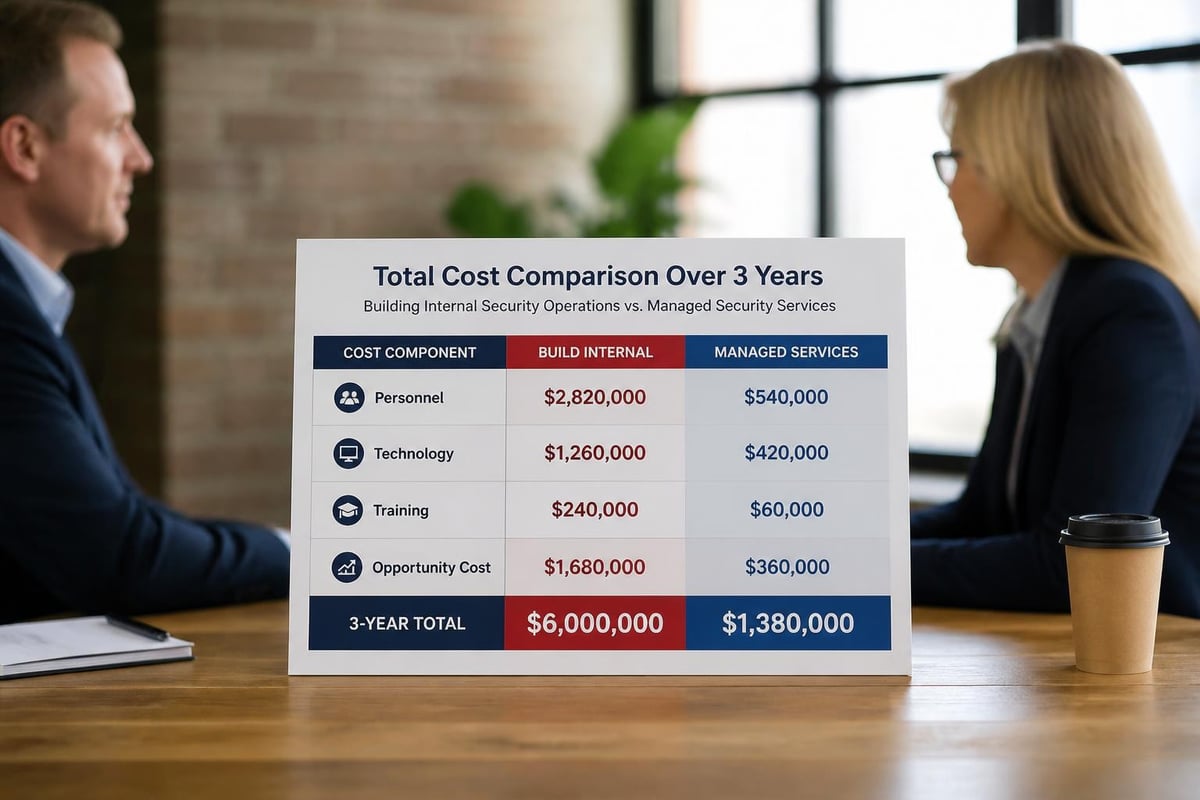
Total Cost of Ownership Comparison
Comparing managed services to internal security teams requires evaluating total cost of ownership, including:
- Personnel costs for salaries, benefits, training, and turnover replacement
- Technology costs for licenses, maintenance, and infrastructure
- Operational costs for 24/7 coverage, backup staff, and escalation procedures
- Opportunity costs when internal teams focus on security instead of strategic initiatives
Organizations in regional markets like Australia, New Zealand, or Dubai often find that recruiting and retaining qualified security professionals presents significant challenges. Managed services provide access to expertise that might be unavailable or prohibitively expensive to employ directly. The 2024 SANS SOC Survey highlights persistent staffing challenges and skill gaps that make external security partnerships attractive for many organizations.
Implementation and Onboarding Process
Transitioning to managed network security services requires structured implementation that establishes baselines, transfers knowledge, and validates service delivery. Well-planned onboarding reduces disruption and accelerates time to value.
Discovery and Environment Assessment
Effective managed services begin with thorough discovery of your current environment, including network architecture, existing security controls, compliance requirements, and operational procedures. Providers need visibility into what they will manage before accepting responsibility for security outcomes.
Expect discovery activities including network diagrams, asset inventories, security tool configurations, policy documentation, and interviews with technical staff. This information allows providers to design appropriate monitoring, establish accurate baselines, and identify gaps that require immediate attention. Organizations can accelerate onboarding by preparing documentation in advance and designating internal stakeholders to support the discovery process.
Transition Planning and Knowledge Transfer
Transitioning security operations from internal teams or previous providers requires careful planning to prevent coverage gaps. Document current security procedures, escalation protocols, vendor relationships, and known issues that the new provider should understand. Schedule transition activities during low-risk periods when possible, and maintain dual coverage for critical functions until the new provider demonstrates operational effectiveness.
Knowledge transfer works bidirectionally. The provider learns your environment, but your team also needs to understand how the managed service operates, what responsibilities remain internal, and how to engage provider resources. Establish regular review meetings, reporting cadences, and communication channels before transitioning operational responsibility.
Performance Monitoring and Service Quality
Ongoing service quality requires defined metrics, regular reporting, and continuous improvement. Organizations should establish performance expectations before engaging providers and monitor delivery throughout the relationship.
Service Level Agreements and Metrics
Service level agreements (SLAs) define measurable commitments covering availability, response times, and performance thresholds. Common managed security SLAs address:
- Monitoring uptime ensuring continuous visibility into security events
- Alert response times establishing how quickly the provider investigates security alerts
- Report delivery guaranteeing regular security reporting on defined schedules
- Vulnerability remediation tracking how quickly identified risks are addressed
- Incident escalation defining when and how the provider escalates serious threats
Effective SLAs balance aspiration with realism. Providers cannot guarantee zero security incidents, but they can commit to detection speed, investigation thoroughness, and documentation quality. Focus on metrics that matter for your risk tolerance and compliance obligations rather than arbitrary targets.
Regular Review and Optimization
Quarterly or monthly service reviews provide opportunities to assess performance, discuss emerging threats, and adjust service scope as your environment evolves. These reviews should examine security metrics, discuss notable incidents, review vulnerability trends, and address any service quality concerns.
Organizations practicing continual improvement programs use these reviews to drive security maturity over time, gradually expanding protection capabilities, refining detection rules, and strengthening incident response procedures based on lessons learned.
Risk Management and Provider Due Diligence
Outsourcing network security creates third-party risk that requires ongoing management. Organizations remain ultimately responsible for security outcomes even when operational tasks are delegated to external providers.
Provider Security Assessment
Before engaging managed security providers, conduct due diligence examining their own security practices. Providers managing your security should demonstrate mature security programs themselves, including:
- Information security management systems certified to standards like ISO 27001
- Personnel security including background checks, confidentiality agreements, and security training
- Operational security covering facility security, access controls, and incident response capability
- Data protection ensuring that any customer data processed or stored receives appropriate protection
- Business continuity demonstrating that provider disruptions will not compromise your security operations
The ENISA implementation guidance on security measures provides useful frameworks for evaluating managed service provider security controls and organizational measures, particularly valuable for organizations in regulated industries.
Contract Considerations and Exit Planning
Managed security contracts should address critical business and technical considerations including service scope, performance standards, liability limitations, data handling, intellectual property ownership, and termination procedures. Pay particular attention to what happens when the relationship ends, ensuring you can retrieve security data, transfer technology ownership if applicable, and maintain continuity if transitioning to another provider.
Organizations managing third-party supplier risk should apply established risk management frameworks to security service providers, conducting initial assessments before engagement and ongoing reviews throughout the relationship.
Managed network security services deliver enterprise-grade protection through specialized expertise, continuous monitoring, and mature security operations that many organizations cannot justify building internally. Success requires careful provider selection, clear scope definition, and ongoing performance management that balances operational delegation with retained organizational accountability. F&C specializes in managed cybersecurity and compliance services, helping organizations understand their risks, build resilience, and establish long-term security partnerships backed by professional certifications. Contact F&C to discuss how managed security services can strengthen your network defenses while supporting your compliance requirements.