
Risk Management Cybersecurity: A Complete Guide for 2026
Risk management cybersecurity has become a strategic imperative for organizations of every size. As digital transformation accelerates and threat actors become more sophisticated, the ability to identify, assess, and mitigate security risks determines whether a business thrives or becomes another breach statistic. For decision-makers in Australia, New Zealand, the United States, and Dubai, effective risk management cybersecurity isn't about eliminating every possible threat-it's about making informed choices that protect what matters most while enabling business growth.
Understanding Risk Management Cybersecurity
Risk management cybersecurity is the systematic process of identifying potential security threats, evaluating their likelihood and impact, and implementing proportionate controls to reduce risk to acceptable levels. Unlike reactive security measures that respond after incidents occur, risk management takes a proactive stance by anticipating threats and building defenses before damage happens.
The discipline combines technical expertise with business acumen. Security teams must understand both the mechanics of how attackers exploit vulnerabilities and the operational priorities that drive the organization. This dual perspective enables risk-based decision-making where investments in security controls align with actual business exposure.
The Business Case for Structured Risk Management
Organizations that implement structured risk management cybersecurity programs achieve measurable advantages. According to the 2025 State of Cyber Risk Management report, companies with mature quantitative risk programs demonstrate 40% better security outcomes and communicate cyber risk more effectively to boards and executives.
Beyond compliance obligations, risk management provides clear visibility into where security budgets deliver the greatest protection. Rather than spreading resources thinly across every possible control, decision-makers can prioritize investments based on actual risk exposure. This precision matters especially for businesses without large in-house security teams.
Key benefits include:
- Reduced likelihood of successful cyberattacks through proactive vulnerability identification
- Lower financial impact when incidents do occur due to prepared response capabilities
- Improved regulatory compliance across frameworks like ISO 27001, SOC 2, and industry-specific standards
- Better cyber insurance terms through demonstrated risk maturity
- Enhanced stakeholder confidence in data protection practices

Core Components of Risk Management Cybersecurity
Effective risk management cybersecurity rests on several interconnected components that work together to reduce organizational exposure.
Asset Identification and Classification
Risk management begins with knowing what you're protecting. Organizations must maintain current inventories of digital assets including servers, applications, databases, cloud services, and endpoints. Each asset requires classification based on its value to the business and the sensitivity of data it processes or stores.
Classification schemes typically use tiers such as critical, high, medium, and low. Critical assets might include customer databases, financial systems, or intellectual property repositories. Lower-tier assets might encompass general office productivity tools with minimal sensitive data.
This classification directly influences protection requirements. Critical assets warrant stronger controls, more frequent monitoring, and stricter access limitations than lower-tier resources.
Threat and Vulnerability Assessment
Once assets are cataloged, organizations must identify relevant threats and existing vulnerabilities. Threats include malicious actors (ransomware gangs, nation-state groups, insider threats), natural disasters, system failures, and human errors.
Vulnerability assessment examines technical weaknesses that threats might exploit-unpatched software, misconfigured cloud storage, weak authentication mechanisms, or inadequate network segmentation. Managed VAPT and Forensics services provide systematic evaluation of these weaknesses across authorized systems, tailored to business objectives and specific assets.
The OWASP Risk Rating Methodology offers practical guidance for assessing application security risks, helping teams determine severity scores that drive remediation priorities.
Risk Analysis and Evaluation
Risk analysis combines threat likelihood with potential business impact to produce risk ratings. A high-likelihood threat against a critical asset with severe potential impact receives a critical risk rating. Conversely, a low-likelihood threat against a non-critical asset might warrant minimal concern.
| Risk Factor | Description | Measurement Approach |
|---|---|---|
| Likelihood | Probability the threat will exploit the vulnerability | Frequency data, threat intelligence, historical trends |
| Impact | Business consequences if exploitation succeeds | Financial loss, operational disruption, reputation damage, regulatory penalties |
| Existing Controls | Current safeguards reducing likelihood or impact | Control effectiveness testing, audit results |
| Risk Score | Combined rating driving treatment decisions | Qualitative scales (high/medium/low) or quantitative values |
Quantitative approaches assign dollar values to potential losses, enabling direct comparison with control costs. Qualitative methods use descriptive scales when precise financial modeling proves difficult. Many organizations use hybrid approaches that combine both perspectives.
Implementing Risk Treatment Strategies
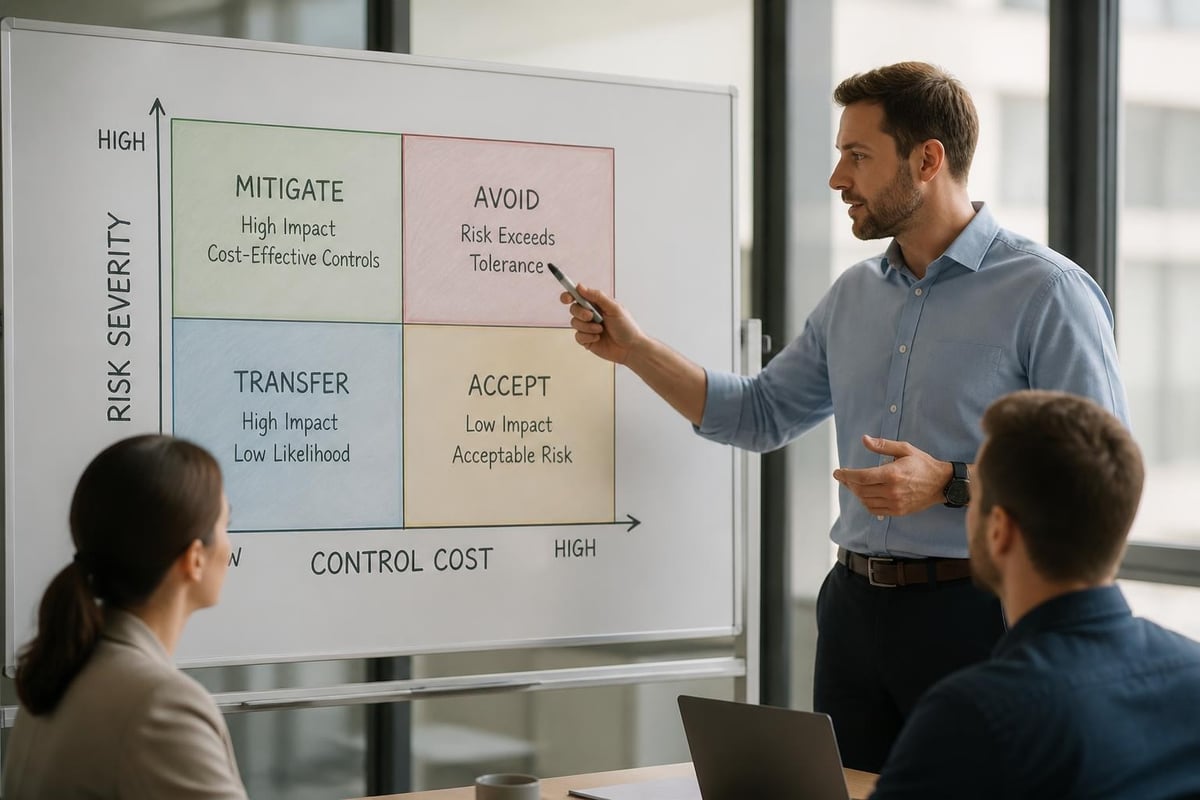
After identifying and analyzing risks, organizations must decide how to respond. Risk management cybersecurity recognizes four fundamental treatment strategies.
Risk Mitigation Through Controls
Mitigation involves implementing security controls that reduce risk to acceptable levels. Controls fall into several categories:
- Preventive controls stop incidents before they occur (firewalls, access controls, encryption)
- Detective controls identify security events during or shortly after occurrence (intrusion detection, log monitoring, anomaly detection)
- Corrective controls restore normal operations after incidents (incident response, backup restoration, patch deployment)
- Compensating controls provide alternative protection when primary controls aren't feasible
The CIS Critical Security Controls offers prioritized technical and organizational safeguards tied directly to risk reduction outcomes. Organizations can map these controls to identified risks, ensuring investments address actual exposures rather than theoretical concerns.
Risk Acceptance and Transfer
Not every risk requires mitigation. Risk acceptance occurs when the cost of controls exceeds potential impact, or when risk falls below organizational tolerance thresholds. Acceptance requires formal documentation and approval from appropriate stakeholders.
Risk transfer shifts financial consequences to third parties through cyber insurance policies or contractual agreements with service providers. Insurance doesn't eliminate technical risk but converts uncertain large losses into predictable premium payments.
Transfer strategies work best for high-impact, low-likelihood scenarios where insurance premiums remain affordable but potential losses could threaten business continuity.
Risk Avoidance
Avoidance eliminates risk by discontinuing the activity that creates exposure. If a legacy application creates unacceptable security risk and migration costs prove prohibitive, decommissioning the application avoids the risk entirely.
While effective, avoidance may conflict with business objectives. Decision-makers must balance risk reduction against operational requirements and strategic goals.
Governance Frameworks for Risk Management Cybersecurity
Structured frameworks provide repeatable processes for managing cybersecurity risk across the organization. These frameworks integrate risk management into broader governance structures.
NIST Risk Management Framework
The NIST Risk Management Framework defines a comprehensive approach for integrating security and privacy risk management throughout system lifecycles. Originally developed for U.S. federal agencies, the framework has gained worldwide adoption across private sector organizations.
The RMF's seven steps create continuous improvement cycles:
- Prepare – Establish organizational context and risk management strategy
- Categorize – Classify information systems based on impact of loss
- Select – Choose appropriate security controls from baseline libraries
- Implement – Deploy selected controls according to specifications
- Assess – Evaluate control effectiveness through testing and examination
- Authorize – Make risk-based decisions to authorize system operation
- Monitor – Continuously track security state and control effectiveness
This lifecycle approach ensures risk management remains active rather than becoming a one-time compliance exercise. Organizations implementing governance frameworks and GRC strategy benefit from structured methodologies that connect daily security operations to strategic business objectives.
ISO 27001 and Risk-Based Information Security
ISO/IEC 27001:2022 embeds risk management cybersecurity into information security management systems (ISMS). The standard requires organizations to establish, implement, maintain, and continually improve security processes based on systematic risk assessment.
ISO 27001's risk-based approach gives organizations flexibility to tailor security controls to actual exposures rather than implementing prescriptive checklists. This flexibility particularly benefits businesses with unique operational models or specialized compliance requirements.
The standard's risk treatment process aligns closely with general risk management principles-identify assets and threats, assess risk levels, select appropriate controls from Annex A, and monitor effectiveness over time.
Practical Steps for Building Your Risk Management Program
Organizations beginning their risk management cybersecurity journey can follow structured steps that build capability progressively.
Step 1: Define Risk Management Scope and Objectives
Start by clearly defining what the risk management program will cover. Will it encompass the entire organization or specific business units? Which asset types fall within scope-only IT infrastructure or also operational technology, physical security, and third-party services?
Document risk tolerance levels and risk appetite statements that guide treatment decisions. These governance documents ensure consistency when different teams face similar risk scenarios.
Step 2: Conduct Comprehensive Risk Assessment
Systematic risk assessment forms the foundation of effective programs. Information security risk management services help organizations identify threats, evaluate vulnerabilities, and prioritize risks according to business impact.
Assessment outputs should include:
- Complete asset inventory with classification levels
- Threat catalog relevant to your industry and geography
- Vulnerability register from technical scanning and process reviews
- Risk register documenting each identified risk with likelihood, impact, and current controls
- Risk heat map visualizing priority risks for executive communication
The Global Cybersecurity Outlook 2025 provides strategic context on emerging risk drivers and trends that should inform threat modeling for forward-looking organizations.
Step 3: Design and Implement Risk Treatment Plans
For each priority risk, develop treatment plans specifying chosen strategy (mitigate, accept, transfer, or avoid), required controls, responsible parties, implementation timeline, and success metrics.
Treatment plans should align with available budget and resource constraints. Phased implementation allows organizations to address critical risks first while building capability for longer-term improvements.
Organizations strengthening their posture can reference CISA's Internet Exposure Reduction Guidance for pragmatic steps that measurably reduce attack surface through practical operational changes.
Step 4: Monitor, Measure, and Refine
Risk management cybersecurity succeeds only through continuous operation. Establish metrics that track both leading indicators (control coverage, vulnerability remediation time) and lagging indicators (incident frequency, impact severity).
Regular monitoring identifies new risks as business and threat landscapes evolve. Quarterly or semi-annual risk reviews ensure the program remains aligned with organizational priorities and emerging threats.
Addressing Specific Risk Domains
Modern risk management cybersecurity must address specialized risk domains that traditional approaches often overlook.
Third-Party and Supply Chain Risk
Organizations increasingly rely on vendors, cloud providers, and business partners who access sensitive data or support critical operations. These relationships create dependencies where third-party security failures become organizational risks.
Effective third-party supplier risk management includes vendor security assessments before onboarding, contractual security requirements, ongoing monitoring of vendor security posture, and incident response coordination across organizational boundaries.
The ENISA Report on the State of Cybersecurity in the Union highlights supply chain attacks as a growing concern across European organizations, with lessons applicable globally about governance and risk maturity requirements.
Emerging Technology Risk
Artificial intelligence, machine learning, and generative AI tools introduce novel risk categories. These technologies process vast data volumes, make autonomous decisions affecting business outcomes, and create new attack vectors through adversarial machine learning and prompt injection.
AI governance and risk management approaches must address both traditional cybersecurity concerns (data protection, access control) and AI-specific risks (model bias, explainability, unintended outputs).
Organizations deploying AI should start with how the technology is used, then determine where safeguards belong across the application lifecycle, business decision processes, and ongoing oversight mechanisms.

Common Challenges and Solutions
Even well-designed risk management cybersecurity programs encounter predictable obstacles that require thoughtful solutions.
Challenge: Limited Resources and Competing Priorities
Small and mid-sized organizations often lack dedicated security teams, making comprehensive risk management seem unattainable. Business leaders must balance security investments against operational needs and growth initiatives.
Solution: Focus on risk-based prioritization rather than attempting comprehensive coverage. Address the highest-impact risks first using cost-effective controls. Managed security services provide specialized expertise without the overhead of full-time security staff. Organizations can access professional-grade capabilities including managed SOC teams that monitor threats and respond to incidents without requiring in-house security operations centers.
Challenge: Rapidly Evolving Threat Landscape
Threat actors continuously develop new attack techniques, making yesterday's risk assessments obsolete. Organizations struggle to maintain current threat intelligence and adjust defenses accordingly.
Solution: Implement continuous monitoring and threat intelligence integration. Subscribe to industry-specific threat feeds and participate in information sharing communities. Regular vulnerability scanning and penetration testing identify emerging weaknesses before attackers exploit them. Quarterly risk reviews incorporate new threat intelligence and vulnerability data to keep risk registers current.
Challenge: Demonstrating Risk Management Value to Executives
Security teams often struggle to communicate technical risks in business terms that resonate with executives and boards. Without clear value demonstration, risk management programs face budget constraints and insufficient executive support.
Solution: Translate technical risks into business impact metrics. Quantify potential financial losses, regulatory penalties, operational disruptions, and reputation damage. Use risk heat maps and executive dashboards that visualize priority risks and control effectiveness. Share metrics showing risk reduction over time and incident prevention outcomes. Real-world case studies demonstrate how similar organizations achieved measurable security improvements through structured risk management.
Integrating Compliance and Risk Management
Regulatory compliance and risk management cybersecurity share common objectives but approach them differently. Compliance focuses on meeting specific regulatory or contractual requirements, while risk management addresses the full spectrum of threats regardless of regulatory mandates.
Compliance-Driven Risk Benefits
Organizations subject to regulations like GDPR, HIPAA, PCI DSS, or Australia's Privacy Act must implement prescribed controls and demonstrate ongoing compliance. These mandates create baseline security requirements that reduce certain risk categories.
Compliance frameworks provide valuable structure for risk programs. Requirements around access control, encryption, incident response, and security monitoring address common vulnerabilities across industries. Organizations can leverage compliance investments to strengthen broader risk management capabilities.
Risk-Driven Compliance Efficiency
Risk management enhances compliance efficiency by identifying which requirements deliver meaningful protection versus those that represent checkbox exercises. Risk assessments reveal gaps where regulatory requirements prove insufficient for actual threat exposures, enabling organizations to exceed minimum compliance with strategically targeted enhancements.
Compliance regulatory assessments help organizations understand obligations and map requirements to risk controls, ensuring compliance investments also reduce actual security risk.
Building Long-Term Risk Management Capability
Sustainable risk management cybersecurity requires more than initial implementation. Organizations must build enduring capability that evolves with changing threats, technologies, and business models.
Developing Internal Expertise
While managed services provide immediate capability, organizations benefit from developing internal risk awareness and foundational skills. Security awareness training programs educate employees about common threats, secure practices, and their role in organizational risk management.
Training should extend beyond end-user awareness to include role-specific education for system administrators, developers, and business leaders. Each group needs relevant knowledge about how their decisions and actions affect organizational risk posture.
Continuous Improvement and Maturity Growth
Risk management maturity follows predictable stages from ad-hoc reactive responses through repeatable processes to optimized programs with continuous improvement. Continual improvement programs establish structured approaches for measuring current maturity, identifying improvement opportunities, and implementing enhancements systematically.
Maturity advancement requires patience and sustained commitment. Organizations should celebrate incremental progress rather than expecting immediate transformation. Each capability improvement reduces risk and builds foundation for subsequent advances.
Leveraging Professional Expertise
Organizations serious about risk management cybersecurity benefit from partnerships with specialized security providers who bring deep expertise, current threat intelligence, and proven methodologies. Professional certifications and experience across diverse client environments enable security partners to accelerate capability development and avoid common pitfalls.
F&C delivers comprehensive risk management support tailored to each organization's specific risk profile, compliance obligations, and business objectives. Our structured approach helps businesses understand their risks, build appropriate defenses, and establish sustainable security practices that protect operations while enabling growth.
Measuring Risk Management Effectiveness
Metrics and key performance indicators transform risk management cybersecurity from abstract processes into measurable business functions with demonstrable value.
Leading Indicators
Leading indicators predict future security outcomes by measuring activities that prevent incidents:
- Vulnerability remediation time: Average days from discovery to patch deployment
- Control coverage percentage: Proportion of identified risks with implemented controls
- Security assessment frequency: Regular completion of vulnerability scans, penetration tests, and control audits
- Training completion rates: Percentage of workforce completing required security awareness programs
- Patch compliance: Percentage of systems current with critical security updates
Lagging Indicators
Lagging indicators measure actual security outcomes after events occur:
- Security incident frequency: Number of confirmed security events per quarter
- Mean time to detect (MTTD): Average time from incident start to detection
- Mean time to respond (MTTR): Average time from detection to containment and recovery
- Financial impact per incident: Direct and indirect costs from security events
- Compliance audit findings: Number and severity of gaps identified during assessments
Balanced scorecards combining leading and lagging indicators provide comprehensive views of program effectiveness and trend direction over time.
Risk management cybersecurity has evolved from technical specialty to business imperative, requiring systematic approaches that identify threats, assess impacts, and implement proportionate controls aligned with organizational priorities. Success requires understanding both technical vulnerabilities and business contexts, continuous monitoring as threats evolve, and measurable processes that demonstrate value to stakeholders. F&C partners with organizations across Australia, New Zealand, the United States, and Dubai to build resilient security postures through expert managed cybersecurity and compliance services tailored to each business's unique risk landscape. Contact our team to discuss how structured risk management can protect your operations while enabling confident growth.