
Security Governance: Building Accountability in 2026
Security governance defines how organizations make decisions about cybersecurity, who holds responsibility for those decisions, and how those responsibilities translate into action. Without governance, security efforts remain tactical and disconnected, driven by individual technical initiatives rather than enterprise objectives. In 2026, business leaders recognize that governance establishes the foundation for every security investment, compliance requirement, and risk decision.
For organizations operating without dedicated internal security teams, security governance becomes even more critical. It bridges the gap between executive accountability and operational capability, clarifying what security means for the business, how it aligns with broader objectives, and who makes decisions when incidents occur or priorities shift.
What Security Governance Actually Means
Security governance encompasses the policies, processes, roles, and structures that direct and control how an organization manages information security. It sits above operational security activities, establishing the framework within which security professionals and business units operate.
Governance answers fundamental questions:
- Who is accountable for security outcomes?
- How are security decisions made and authorized?
- What standards and frameworks guide security activities?
- How is security performance measured and reported?
- Where does security fit within enterprise risk management?
These questions require answers that reflect business context, regulatory obligations, and stakeholder expectations. The NIST Cybersecurity Framework 2.0 emphasizes governance as a foundational function, recognizing that effective security programs require clear organizational structures and accountability mechanisms before technical controls deliver value.
Governance Versus Management Versus Operations
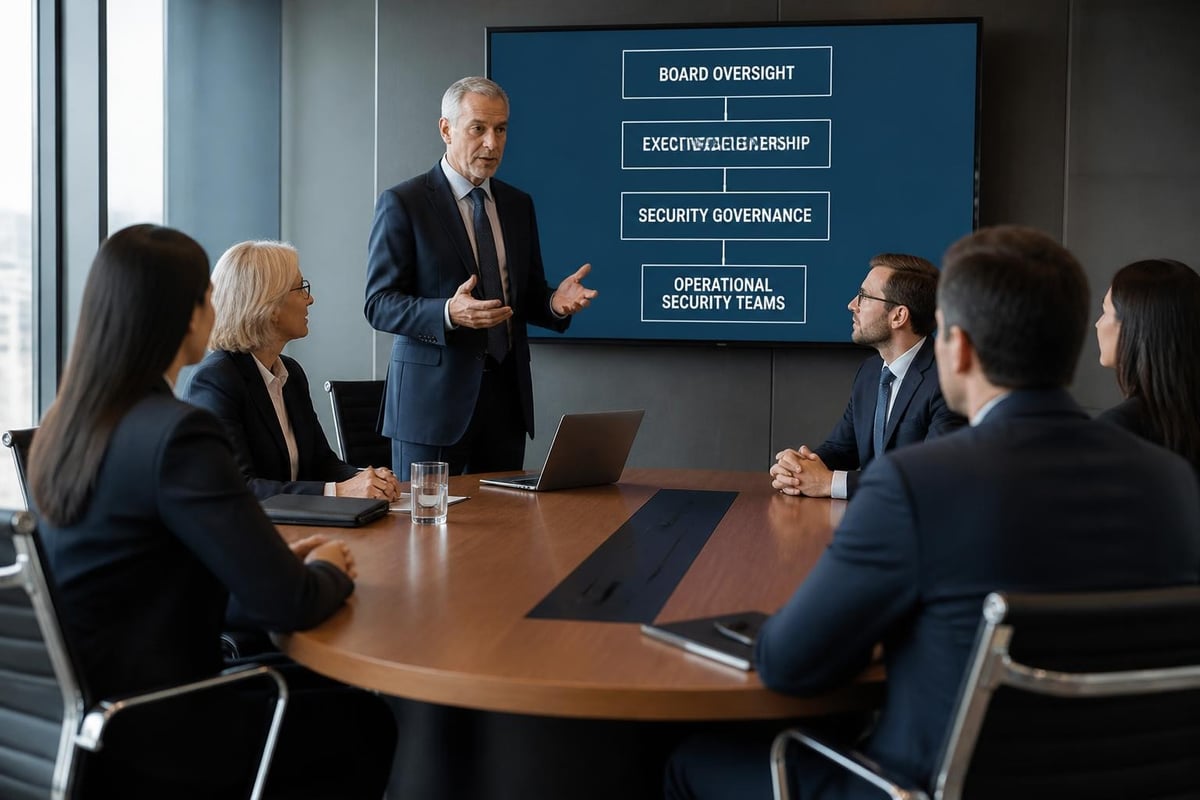
Security governance defines direction and accountability. Security management translates governance decisions into programs, processes, and resources. Security operations execute the technical and procedural activities that protect systems and data.
These three layers operate in concert but serve distinct purposes. Governance establishes policy; management implements controls; operations monitors and responds. Confusion among these layers leads to misaligned expectations, duplicated effort, and gaps in coverage.
Organizations designing governance frameworks and GRC strategy benefit from explicitly mapping these boundaries, particularly when relying on external partners for managed security services. Clarity about who governs, who manages, and who operates prevents friction and ensures accountability remains visible.
Core Components of Security Governance
Effective security governance programs share common structural elements. These components establish the foundation upon which all security activities build.
Policies, Standards, and Procedures
Policies articulate high-level security objectives and principles approved by executive leadership or the board. They establish organizational commitments and boundaries.
Standards specify mandatory requirements, technologies, or configurations that fulfill policy objectives. They provide measurable criteria for compliance.
Procedures document step-by-step instructions for executing security activities, from password resets to incident escalation.
Each layer serves a different audience and purpose. Policies guide strategic decisions; standards enforce consistency; procedures enable execution. Organizations often struggle when these documents conflict, overlap, or remain disconnected from operational reality. Regular review cycles and stakeholder input ensure policies, standards, and procedures reflect current risk and business context.
| Governance Component | Purpose | Owner | Review Frequency |
|---|---|---|---|
| Security Policy | Strategic direction and commitments | Board / Executive | Annual |
| Technical Standards | Mandatory configurations and controls | Security Leadership | Quarterly |
| Operational Procedures | Step-by-step execution guidance | Operations Teams | As needed |
| Risk Register | Identified threats and treatment plans | Risk Management | Monthly |
Roles, Responsibilities, and Accountability
Security governance fails when accountability remains ambiguous. Clear assignment of roles, responsibilities, and accountability ensures decision rights align with expertise and authority.
Common governance roles include:
- Board or audit committee oversight
- Chief Information Security Officer (CISO) or equivalent executive
- Security steering committee or governance board
- Information asset owners
- Control owners and process managers
- Third-party service providers
Many mid-sized organizations lack formal CISO positions. In these environments, security governance often falls to finance leaders, operations directors, or external advisors. What matters is explicit documentation of who makes security decisions, approves exceptions, and answers to regulators or stakeholders when issues arise.
Research from Harvard Business Review highlights persistent gaps in board-level cybersecurity oversight, particularly regarding metrics, reporting quality, and director expertise. Organizations close these gaps by establishing regular reporting cadences, translating technical risks into business impact, and equipping boards with decision-ready information rather than technical detail.
Aligning Security Governance with Business Objectives
Security governance divorced from business strategy creates compliance theater-activity without impact. Effective governance integrates security into enterprise risk management, strategic planning, and resource allocation.

Risk-Based Governance Frameworks
Risk drives governance priorities. Organizations with mature security governance programs tie every control, investment, and policy decision back to identified risks and their potential business impact.
Information security risk management provides the analytical foundation for governance decisions. Risk assessments identify threats, vulnerabilities, and potential consequences. Governance structures then determine acceptable risk levels, allocate resources for treatment, and monitor residual risk over time.
The ISACA COBIT framework offers comprehensive guidance for linking IT governance to enterprise objectives. COBIT helps organizations map security activities to business goals, establish performance indicators, and design governance structures that reflect organizational complexity and industry context.
Regulatory and Compliance Drivers
Compliance obligations heavily influence security governance design. Regulations impose specific requirements for policies, controls, reporting, and accountability. Governance frameworks ensure these requirements translate into consistent practice across the organization.
Different jurisdictions and industries impose varying requirements:
- Financial services face requirements from banking regulators and payment card standards
- Healthcare organizations manage patient privacy under health information protection laws
- Government contractors address security control baselines and supply chain requirements
- International operations navigate data protection regulations across multiple territories
Organizations operating across multiple jurisdictions benefit from governance frameworks that meet the highest common requirements while allowing localized implementation where regulations diverge. This approach reduces duplication while maintaining compliance across territories.
F&C supports clients in navigating these complex requirements through compliance and regulatory assessments that map obligations to controls, identify gaps, and prioritize remediation based on risk and regulatory consequence.
Implementing Governance Frameworks
Governance frameworks provide structure and consistency. They establish common language, processes, and expectations that guide security activities regardless of organizational change or personnel turnover.
Selecting and Adapting Frameworks
Popular security governance frameworks include:
- NIST Cybersecurity Framework (CSF) - comprehensive guidance across identify, protect, detect, respond, and recover functions
- ISO/IEC 27001 - international standard for information security management systems with certification pathway
- COBIT - enterprise governance framework linking IT and security to business objectives
- CIS Controls - prioritized, prescriptive security controls organized by implementation group
- NIST Risk Management Framework (RMF) - formalized process for authorization, continuous monitoring, and control assessment
No single framework fits every organization. Selection criteria include industry norms, regulatory expectations, organizational maturity, available resources, and certification requirements.
Many organizations adopt hybrid approaches, using one framework as primary structure while incorporating elements from others. For example, an organization might implement ISO 27001 ISMS for certification purposes while referencing NIST CSF for operational guidance and COBIT for board-level governance reporting.
Governance Implementation Roadmap
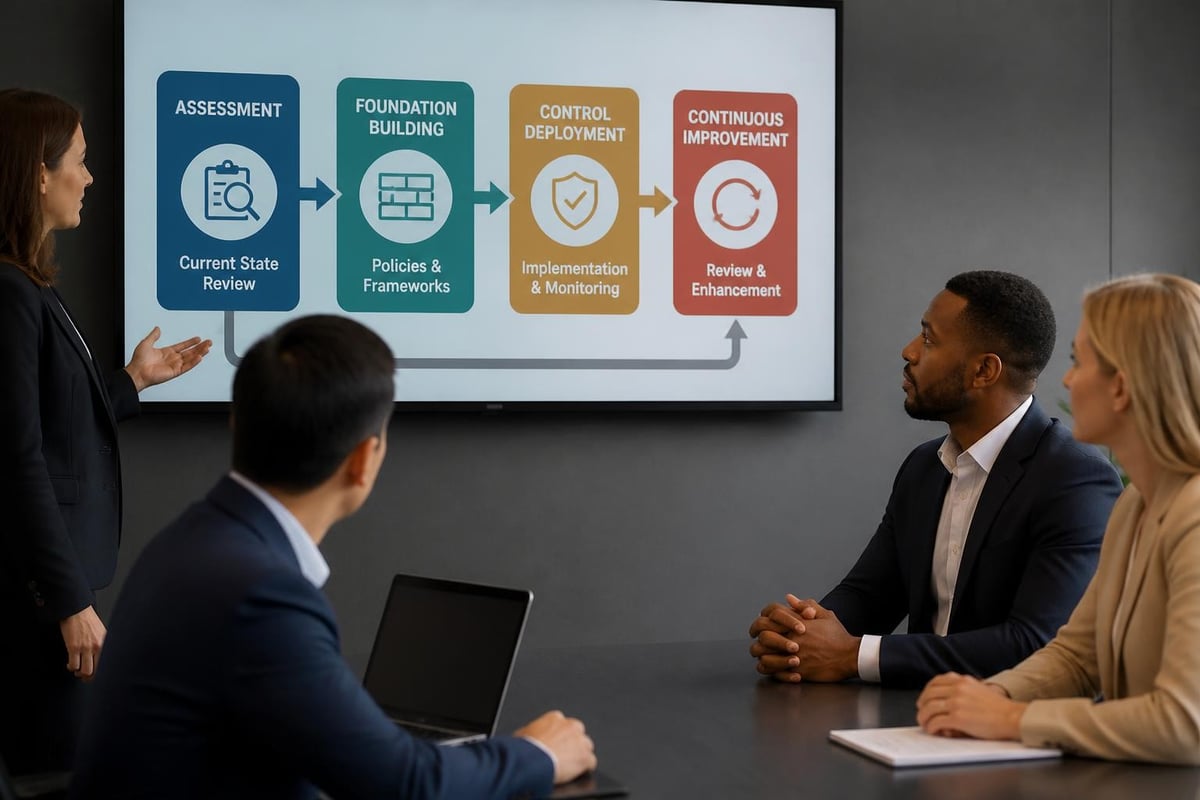
Implementing security governance follows a structured progression:
Phase 1: Assessment and Planning
- Document current state governance structures, policies, and processes
- Identify gaps against selected framework and regulatory requirements
- Define target governance model and implementation priorities
- Secure executive sponsorship and resource commitments
Phase 2: Foundation Building
- Establish governance bodies (steering committees, working groups)
- Define and document roles, responsibilities, and decision authorities
- Develop or update core security policies aligned with business objectives
- Implement risk assessment processes and initial risk register
Phase 3: Control Implementation
- Deploy technical and procedural controls based on risk priorities
- Establish monitoring, measurement, and reporting mechanisms
- Train staff on governance processes, policies, and responsibilities
- Document evidence for compliance and audit purposes
Phase 4: Continuous Improvement
- Regular policy and framework reviews aligned with business change
- Ongoing risk assessments and treatment plan updates
- Metrics review and governance effectiveness measurement
- Lessons learned integration from incidents and audit findings
Organizations without internal security expertise often engage external partners during implementation. Managed service providers bring framework knowledge, implementation experience, and ongoing operational capability, allowing governance structures to function effectively without building internal teams.
Governance for Third-Party and Supply Chain Risk
Security governance extends beyond organizational boundaries. Third-party vendors, service providers, cloud platforms, and supply chain partners create risk exposure requiring governance oversight.
Third-Party Risk Governance
Effective third-party and supplier risk governance includes:
- Vendor security assessment before contract execution
- Contractual requirements for security controls and incident notification
- Ongoing monitoring of vendor security posture and compliance
- Regular reviews of vendor performance against security obligations
- Clear escalation paths when vendor security issues emerge
Organizations establish tiering systems that match governance rigor to vendor criticality and data sensitivity. High-risk vendors handling sensitive data or critical systems face extensive assessment and monitoring. Lower-risk vendors receive lighter-touch evaluation proportional to their access and impact.
Cloud and Managed Service Governance
Cloud service providers and managed security service providers (MSSPs) require specific governance considerations. Shared responsibility models split control accountability between customer and provider. Governance frameworks must clearly delineate:
- Which controls the provider manages (infrastructure, physical security, platform security)
- Which controls remain customer responsibility (data classification, access management, application security)
- How both parties monitor, report, and respond to security events
- Where compliance evidence originates and how auditors verify controls
Organizations leveraging managed cybersecurity services benefit from explicit service level agreements that document governance boundaries, reporting requirements, and escalation procedures. Clear documentation prevents misunderstandings about who manages specific security functions.
Measuring Governance Effectiveness
Security governance requires measurement to demonstrate value and identify improvement opportunities. Effective metrics align with governance objectives and provide decision-ready information to stakeholders at appropriate levels.
Governance Metrics and Reporting
Board and executive metrics focus on strategic and risk indicators:
- Percentage of critical risks with approved treatment plans
- Policy compliance rates across business units
- Security incidents by severity and business impact
- Regulatory compliance status and audit findings
- Security budget allocation versus identified risk priorities
Operational metrics track program execution and control effectiveness:
- Control implementation status against defined timelines
- Vulnerability remediation cycle times
- Training completion rates by role and department
- Mean time to detect and respond to security events
- Repeat findings from audits and assessments
Metrics become meaningful when tracked consistently over time, benchmarked against peer organizations or industry standards, and tied to specific governance decisions or improvement initiatives. Raw data without context creates confusion rather than clarity.
The NIST CSF 2.0 framework document provides detailed guidance on governance measurement, linking metrics to specific outcomes and implementation tiers. Organizations adapt these recommendations to their specific context, industry requirements, and stakeholder expectations.
Audit and Assurance Functions
Independent verification validates governance effectiveness and builds stakeholder confidence. Internal audits, external assessments, and certification programs each serve distinct assurance purposes.
Internal audit and management review processes examine whether governance structures function as designed, whether policies align with practice, and whether controls operate effectively. Regular internal reviews identify gaps before external auditors or regulators discover them.
External certifications like ISO 27001 provide independent validation of governance frameworks and control implementation. The certification process requires documented evidence of policy effectiveness, risk management, and continuous improvement. Organizations pursue certification for competitive advantage, regulatory compliance, or stakeholder confidence.
Governance Challenges and Practical Solutions
Security governance faces predictable challenges. Awareness of common obstacles enables proactive mitigation.
Challenge: Governance structures perceived as bureaucratic overhead Solution: Demonstrate governance value through risk reduction, incident prevention, and compliance efficiency. Share metrics showing governance preventing problems rather than just documenting them.
Challenge: Difficulty maintaining governance momentum during business change Solution: Embed governance reviews into existing business processes like strategic planning, merger integration, and product development. Make governance a checkpoint rather than a separate activity.
Challenge: Limited resources for governance activities Solution: Prioritize governance efforts based on risk. Automate evidence collection and reporting where possible. Consider external support for specialized governance functions like control design and implementation.
Challenge: Keeping policies and procedures current Solution: Establish regular review cycles tied to business planning calendars. Assign document ownership to roles, not individuals. Use version control and change management for governance documentation.
Challenge: Resistance from operational teams Solution: Involve operational staff in governance design. Explain the business rationale behind governance requirements. Provide training on how governance protects both the organization and individual employees.
Governance for Emerging Technologies
Emerging technologies like artificial intelligence, machine learning, and autonomous systems introduce novel governance challenges. Traditional security governance frameworks address infrastructure and applications but often lack specific guidance for AI systems.
AI governance and risk management extends existing security governance with considerations specific to AI systems: data provenance, model training integrity, bias and fairness, explainability, and autonomous decision boundaries. Organizations deploying AI capabilities need governance structures that address both traditional security concerns and AI-specific risks.
Public sector organizations often face additional governance requirements. CISA guidance outlines expectations for government entities establishing cybersecurity governance structures, including planning requirements, stakeholder coordination, and accountability mechanisms.
Governance Maturity and Evolution
Security governance maturity progresses through recognizable stages. Understanding these stages helps organizations assess current capability and plan improvement paths.
| Maturity Level | Characteristics | Typical Challenges |
|---|---|---|
| Initial | Ad hoc security activities, unclear accountability, reactive posture | Inconsistent practices, compliance gaps, repeated incidents |
| Developing | Documented policies, defined roles, basic controls implemented | Limited integration, manual processes, siloed efforts |
| Defined | Comprehensive frameworks, integrated processes, proactive management | Sustaining momentum, resource constraints, measuring effectiveness |
| Managed | Quantitative measurement, continuous improvement, risk-based optimization | Adapting to change, emerging threats, technology evolution |
| Optimizing | Strategic alignment, predictive capabilities, industry leadership | Maintaining innovation, balancing automation with oversight |
Organizations advance through maturity levels based on business drivers, resource availability, and leadership commitment. Progression is neither linear nor mandatory-the appropriate maturity level depends on risk profile, regulatory obligations, and stakeholder expectations.
Mid-sized organizations often target "Defined" or "Managed" maturity levels. These levels provide strong governance foundations without the extensive resources required for optimization. External partnerships help organizations achieve higher maturity levels by supplementing internal capabilities with specialized expertise and operational scale.
Building Sustainable Governance Programs
Sustainable security governance balances structure with flexibility, enabling consistent risk management while adapting to business evolution and threat landscape changes.
Integration with Enterprise Governance
Security governance operates most effectively when integrated with broader enterprise governance structures. Organizations benefit from aligning security governance with:
- Enterprise risk management committees and processes
- Compliance and regulatory management programs
- Internal audit and assurance functions
- Business continuity and resilience planning
- Strategic planning and investment cycles
This integration ensures security considerations influence business decisions at appropriate points and that security governance reflects enterprise priorities rather than operating in isolation.
The ENISA framework guidance provides valuable perspective on governance integration, coordination mechanisms, and implementation approaches particularly relevant for large or complex organizations.
Continuous Improvement Mechanisms
Effective governance frameworks incorporate continual improvement programs that systematically capture lessons, measure performance, and drive enhancement. Improvement inputs include:
- Security incident post-mortems and root cause analysis
- Audit findings and management responses
- Risk assessment updates and emerging threat intelligence
- Control effectiveness assessments and testing results
- Stakeholder feedback from business units and leadership
Regular governance reviews examine framework effectiveness, identify optimization opportunities, and ensure governance structures remain aligned with business objectives. These reviews prevent governance frameworks from becoming static documentation disconnected from organizational reality.
Culture and Awareness
Security governance succeeds only when organizational culture supports it. Security awareness training helps staff understand governance objectives, their individual responsibilities, and how security decisions impact business outcomes.
Culture development extends beyond training programs. Leadership behavior, resource allocation, consequence management, and communication patterns all influence whether governance frameworks guide actual behavior or exist only on paper. Organizations build security-conscious cultures by consistently reinforcing governance principles through decisions, recognition, and accountability.
Security governance establishes the leadership, accountability, and structure that transforms security from technical activity into business capability. Organizations that invest in governance frameworks appropriate to their risk profile, compliance obligations, and operational complexity position themselves to manage evolving threats while supporting business objectives. F&C helps organizations across Australia, New Zealand, the United States, and Dubai build practical governance programs that establish accountability, enable compliance, and create long-term resilience. Contact F&C to discuss how we can support your security governance requirements.